
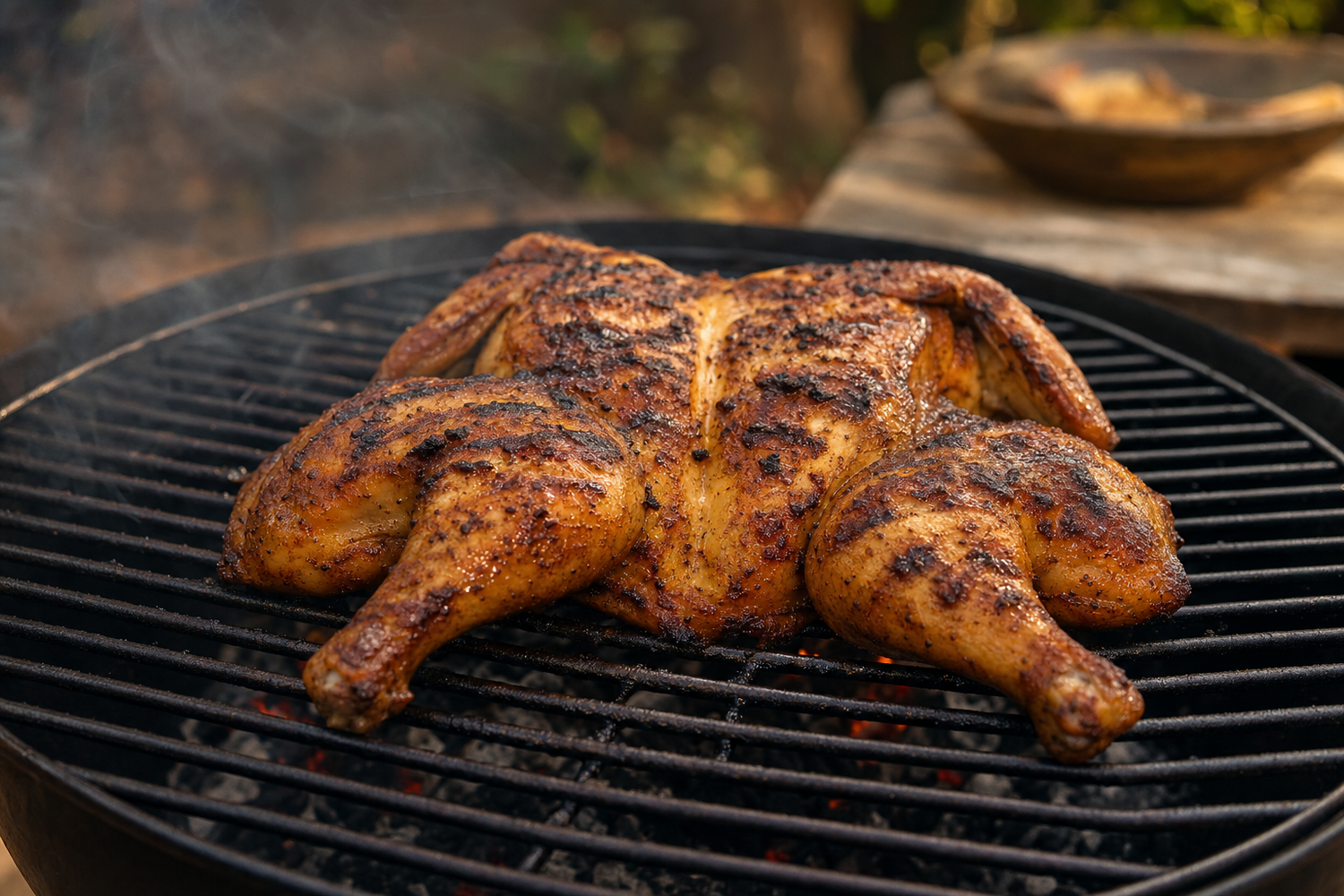
Beer-can chicken looks great in photos. The upright bird, the sweating can, the promise of steam-infused flavor from the inside out -- it is one of those backyard techniques that feels scientific even when you are just winging it. The problem: the science does not hold up. The beer in that can almost certainly never reaches a boil. No meaningful steam enters the cavity. The flavor contribution is effectively zero. And you are cooking an awkward sphere of poultry for 90 minutes when a flat bird would be done in 45.
Spatchcocking -- removing the backbone and pressing the bird flat -- is not a trick. It is the answer to every problem whole-bird grilling creates.

What the Temperature Data Actually Shows About Beer-Can Chicken
According to ThermoWorks' thermal analysis of beer-can chicken, the liquid inside the can rarely reaches boiling temperature during a typical cook. The cavity interior stays cooler than the exterior because the can itself acts as a heat sink. Rather than steaming the bird, the can simply sits in a lukewarm bath of beer that never converts to meaningful vapor.
Kenji Lopez-Alt at Serious Eats tested this directly: three chickens cooked simultaneously on beer, on a can filled with dried beans, and on a can of iced tea. Blind tasting by a fresh palate found no difference in flavor or texture between any of the three. Moisture loss, measured by pre- and post-cook weight, was identical across all birds. The beer does nothing. The upright position does help with airflow, but that benefit is trivially achieved by better methods.
What you are left with is a 90-minute cook for a bird that is nearly impossible to probe accurately in its upright configuration, prone to tipping, and delivering uneven results because the thermal geometry of a sphere is the worst possible shape for even cooking.
The Physics of Spatchcocking
According to The Grilling Science's detailed temperature analysis, a whole chicken has a breast-to-thigh doneness gap of 15 to 25 minutes. The breast reaches safe temperature and keeps climbing while the thighs finish. Every minute of that gap is moisture leaving your white meat. The result is dry breast meat, regardless of what technique you use to prop the bird upright.
When you spatchcock, you convert a sphere into a slab roughly 2 to 2.5 inches thick across the entire bird. The breast, thighs, and legs all sit at approximately the same distance from the heat source. In controlled temperature logging tests, that breast-to-thigh doneness gap drops from 15 to 25 minutes down to 3 to 5 minutes. The breast finishes right as the thighs finish. Nothing overcooks.
The flattened bird also exposes approximately 40% more surface area to direct heat than the same bird standing upright. More surface area means faster, more even heat absorption. It is the same principle that makes a thin steak cook faster than a thick one -- surface-to-volume ratio drives everything.
How to Actually Do It (The Two-Minute Prep)
Place the bird breast-side down. Cut along both sides of the backbone with kitchen shears and remove it -- save it for stock. Flip breast-side up and press down firmly on the breastbone with both palms until it cracks flat. Tuck the wing tips behind the breast. Two cuts, one press, under two minutes.

The Grill Method: Two-Zone Setup for Crispy Skin
Set up a two-zone fire: direct heat at 450 to 500 degrees on one side, indirect at 350 to 375 degrees on the other. Place the spatchcocked bird skin-side up over indirect heat. The skin faces away from the direct flame, allowing fat to render slowly without burning.
Cook until the breast reads 155 degrees -- at this point the thighs will be around 165 to 170 degrees. Flip the bird skin-side down directly over the hot side for 5 to 8 minutes. The already-rendered skin crisps rapidly. The breast climbs the final 10 degrees from residual heat and carryover. Rest for 10 minutes.
Total time on a 4-pound bird: 45 to 55 minutes. Compare that to 75 to 90 minutes for whole-bird methods. You save 30 minutes and get a better result on every measurable metric -- cook time, temperature evenness, skin texture, and moisture in the breast.
The Dripping Problem (Where Your Grill Pays the Price)
Spatchcock chickens drip aggressively. A flat bird renders fat straight down onto your lid liner, side panels, and grill exterior. Rendered poultry fat at 400+ degrees bonds to powder coat and porcelain enamel, then bakes into a varnish layer that standard cleaning struggles to lift. If your grill surfaces have a ceramic barrier -- like Grillacoat -- those drippings wipe away instead of becoming permanent stains. Cook this way consistently and a protected finish makes a real difference.
The Short Answer
Beer-can chicken is a gimmick with good marketing. Spatchcock chicken is a physics problem solved correctly. The beer adds nothing, the upright position creates uneven cooking, and the 90-minute timeline is unnecessary. Two cuts, 45 minutes, and better results in every direction.
Switch once and you will not go back. The beer, meanwhile, is better cold in a glass. When you are ready to protect the grill that takes the punishment, Grillacoat ships free with a 30-day guarantee.