
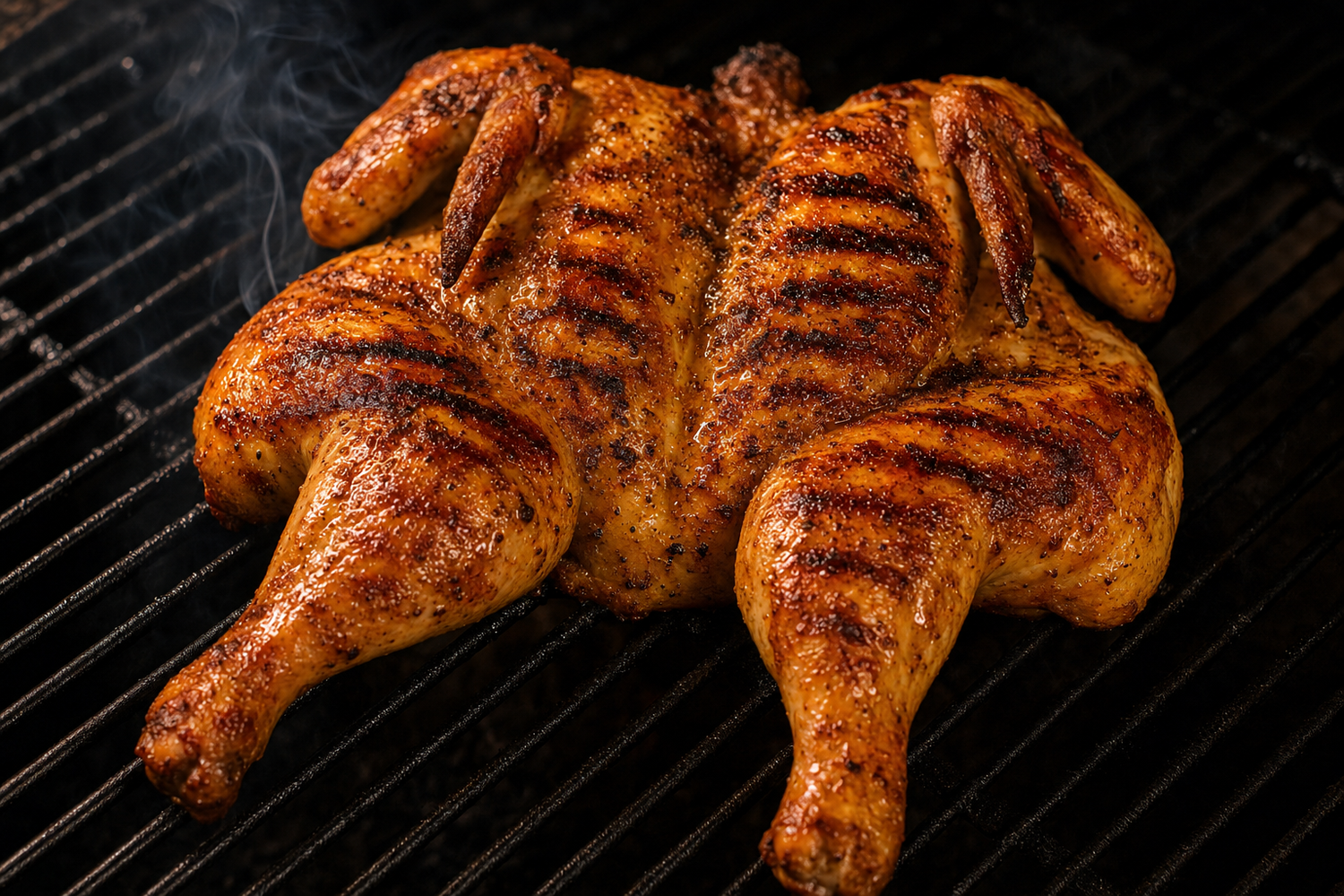
You have done this cook. Whole bird, breast up, lid down, indirect heat. Ninety minutes later you slice into the breast and it is dry. The thighs are still pink at the joint. So you cook it longer next time, and the breast gets even drier.
The problem is not your grill. It is the shape of the chicken. A whole bird is a thermodynamic disaster -- a thick breast on top of a hollow cavity, with thighs sticking out into completely different heat zones. There is no temperature that finishes all of it at once. So you pick a side: dry breast or raw thigh.
The fix is a pair of kitchen shears and two minutes of work. It is called spatchcocking, and it cuts your cook time in half while solving the doneness problem entirely.

What Spatchcocking Actually Does to the Physics
Flip the bird breast-side down, cut along both sides of the backbone with shears, lift it out, then flip the chicken over and press down on the breastbone until you hear a crack. The bird now lies flat. That is it.
What you have just done is geometry. A whole roasting chicken is roughly four inches thick at the breast. A spatchcocked bird is closer to two inches thick across the entire surface. Heat has half as far to travel to reach the center, and it reaches every part of the bird at roughly the same rate.
The grilling-science crowd has measured this. A 4-pound whole bird on a 350-degree grill takes 75 to 90 minutes. The same bird spatchcocked finishes in 40 to 45 minutes on a two-zone setup, with breast at 165 and thighs at 175 to 180 at the same moment (The Grilling Science). You are not just cooking faster. You are cooking correctly, because the breast hits its safe pull temperature in the same window the dark meat is finally rendered enough to be tender.
The Skin Is the Real Magic Trick
Here is the part nobody tells you. When the chicken lies flat skin-up, every square inch of skin is exposed to convective heat at the same angle. Fat renders evenly. There are no pockets where the wing tucks into the body and steams itself into rubber.
That is why every restaurant chef who cooks chicken at volume spatchcocks. It is the only way to get the skin uniformly crisp across the whole bird in a single cook. Roast at 425 to 500 degrees with the skin up, then for the last five to eight minutes flip the bird skin-side down onto the direct-heat side of the grill (Hey Grill, Hey). The fat is already mostly rendered, so the skin shatters into the lacquered, brown crust you only get at good rotisseries.
The Two-Zone Setup That Makes This Work
Light only one side of your gas grill, or bank coals to one side on charcoal. You want roughly 450 to 500 degrees on the direct side and 350 to 375 ambient on the indirect side. Place the bird skin-up on the indirect side. Lid down. Walk away for 25 minutes.
Probe the thickest part of the breast. When it reads 150 to 155, lift the bird, slide it over to the direct-heat side skin-down, and sear for 5 to 8 minutes. Pull at 160 internal in the breast -- carryover will take it to 163 to 165 during the rest. Thighs will be 175 to 180, which is exactly where dark meat tastes best (Chef's Circle). Rest for ten minutes. Do not skip the rest.

Why This Cook Eats Grills Alive Without Protection
Here is the catch nobody warns you about. A spatchcocked bird renders fat across a wide, flat area straight down onto your grates and into the firebox below. You are running 450-degree direct heat with chicken fat pooling and vaporizing. That is exactly the cycle that turns shiny grates into pitted black bars and eats through a porcelain-coated firebox in two seasons.
This is why a treated grill cooks differently. Grillacoat bonds a thin ceramic layer across the firebox exterior, lid liner, side panels, and the rest of the non-cooking metal so the rendered fat that escapes the grates does not weld itself into bare steel. After the cook, the grease wipes off cold the next morning -- no overnight scrubbing of the lid, no permanent staining on the firebox shoulders. Your cooking grates themselves still need a wooden scraper or coil brush before the next cook, because crispy chicken skin requires direct, uninterrupted contact with a clean grate. Protecting the surrounding metal just means the rest of the grill is not fighting you while you focus on the cooking surface.
The First Time You Do This
Buy a four-pound bird. Salt it under the skin the night before if you can -- a dry brine pulls moisture out and makes the skin even crisper. Cut along the backbone with sharp shears, press flat, and you are ready. Forty minutes later you will pull off a chicken with skin that crackles and breast meat that runs juice when you slice it.
The first time you do it you will think about every whole chicken you have ever overcooked. That is the right reaction. A flat bird and a grill built to handle the fat it renders is the whole game.