
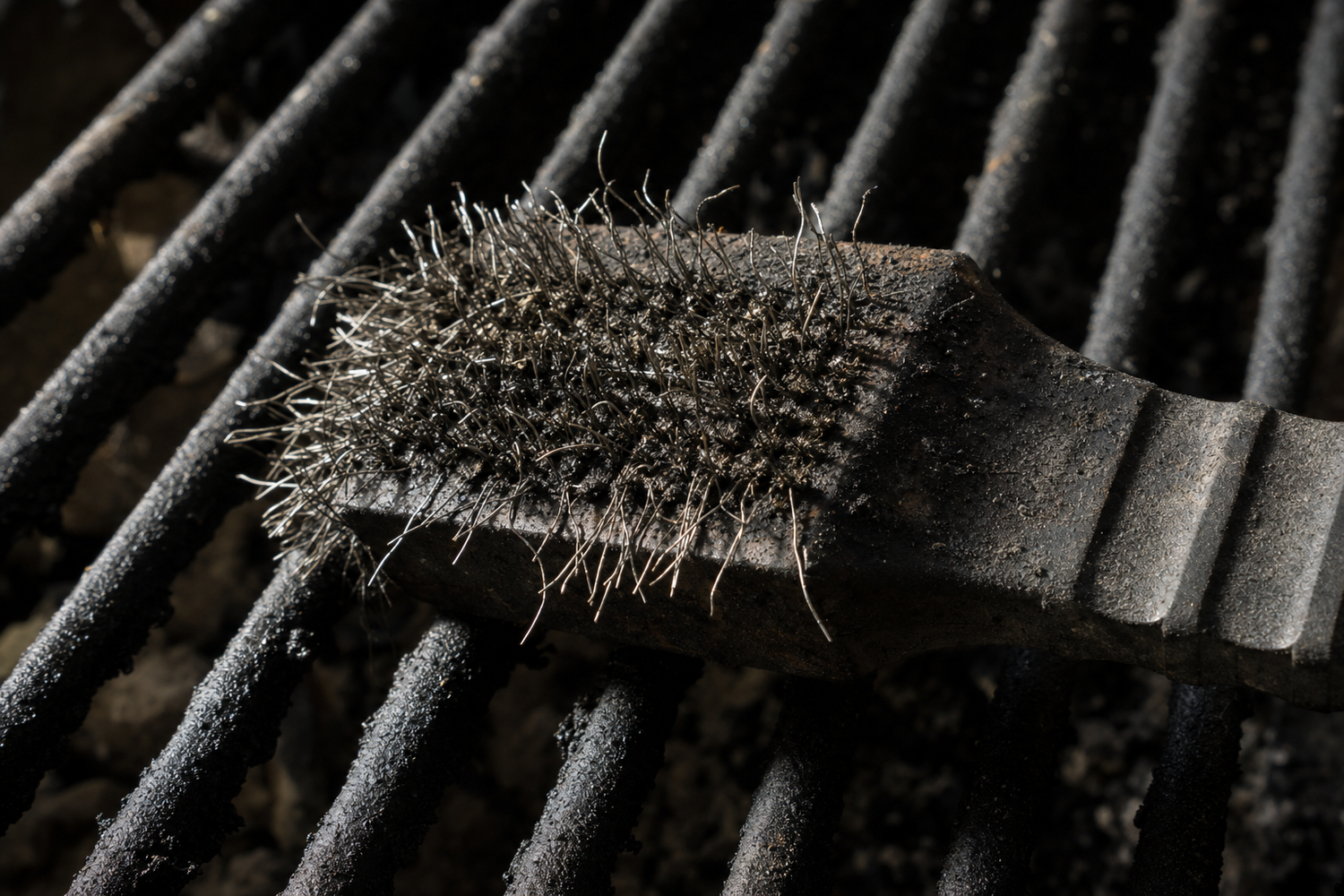
The grill brush in your garage is probably a $10 hardware-store impulse buy. It also happens to be the single most dangerous tool in most backyards. In early 2026 Weber recalled 3.2 million wire-bristle grill brushes for posing an ingestion hazard. Across the industry, more than 13 million wire brushes have been recalled. And a new 2026 epidemiology study counted 3,739 emergency-room visits from wire-bristle ingestion between 2015 and 2023 -- more than double the 1,698 visits the prior national study found from 2002 to 2014.
The CDC warned about this in 2012. Fourteen years later the injury rate has gone up, not down. Roughly one in four bristle-ingestion patients now requires hospital admission. The peak months are June, July, and August.

How a Steel Bristle Ends Up in Your Throat
The mechanism is mundane. Every time you scrub a hot grate with a wire brush, a few of the brush's tiny stainless filaments work loose. Most fall through the grate into the firebox. Some stick to the grate. The next time you cook a steak or chicken thigh, a bristle the size of a sewing needle ends up embedded in the crust. You do not see it. You do not feel it. You swallow it.
If you are lucky, it lodges in the oropharynx and an ENT pulls it out the same day. If you are not, it travels into the gastrointestinal tract. Injuries documented in the literature include perforated esophagus, perforated small bowel, sigmoid colon perforation, and hepatic abscess formation -- all requiring emergency surgery (American College of Surgeons case review). One of the 2026 case series patients needed a laparotomy.
The CDC, the American Medical Association, and Health Canada have all issued formal warnings (CDC MMWR 2012). The 2026 follow-up study explicitly concluded that "the many warnings and awareness efforts over the last decade had not reduced the injury rate."
Why the Recalls Are Still Not Solving It
Two reasons. First, recalled brushes still sit in millions of garages because nobody registered theirs or checks recall notices. Second, the next $8 wire brush at the hardware store is functionally identical to the recalled ones. The recall fixes one SKU. The basic design -- steel filaments crimped into a ferrule, scrubbed hot against another metal surface -- sheds bristles by physics.
You can mitigate. Inspect the brush before every use. Check the grate with a paper towel before laying meat on it. Replace brushes every season. But the safest move is the one Good Housekeeping, NBC News, and most medical professionals now openly recommend: stop using wire-bristle brushes (Good Housekeeping bristle-free roundup).
What Actually Cleans a Grate Without Killing You
The grilling-tool industry has spent ten years building alternatives. The honest ones fall into three buckets.
Wooden scrapers. A hardwood paddle that you press against a hot grate. The grate burns its own custom grooves into the wood after the first cook, and from then on it scrapes off carbonized residue with zero shed risk. Cheap, dumb, and effective.
Bristle-free steel-coil brushes. Brands like Grillart wind a continuous stainless coil around a head -- no individual bristles to break off. Aggressive enough for cast iron, no detachment failure mode.
Steam cleaners and grate stones. A nylon scrub pad wetted with hot water, or a pumice-style grill stone. Both rely on chemistry and friction instead of metal-on-metal scrubbing.
All three work. All three require more effort than a wire brush, mostly because a wire brush is doing damage you cannot see -- to your grate and potentially to your stomach.

The Real Win Is Not Cleaning Less -- It Is Cleaning Easier
Here is the part the safety articles undersell. The reason backyards still buy wire brushes is that everything else seems like work. Wood scrapers and bristle-free brushes can struggle against fully carbonized, bonded-on grease. So most cooks reach for the most aggressive tool they own.
The way out for the rest of your grill is upstream. The lid liner, firebox shoulders, side panels, and exterior metal collect the same burnt-on grease as the grates -- and that is usually where people reach for the wire brush out of habit. Grillacoat applies a thin ceramic layer to those non-cooking surfaces so rendered fat sits on top of the coating instead of welding into bare metal. The residue lifts off cold with a microfiber cloth or wooden scraper in seconds -- no wire, no scrubbing, no metal filaments shedding from your lid liner into your next meal. Your cooking grates themselves still need a wooden scraper or a bristle-free coil brush, but coating everything around them removes the wire-brush habit from the rest of your cleanup.
That is the actual safety story nobody is telling. Wire brushes exist because every untreated grill surface -- grates, lid, firebox -- bakes its own grease into a layer that needs aggressive metal to remove. Coat the surfaces you can, use a wooden scraper or coil brush on the grates, and the wire-brush habit disappears with it.
What to Do This Weekend
Open your garage. If your grill brush has wire bristles, throw it out. Check the CPSC recall list for your brand. Replace it with a wooden scraper or a bristle-free coil brush -- both run $15 to $30. And while you are at it, treat the surfaces around your grates -- the lid, the firebox exterior, the side panels, the hardware -- so the next decade of cleaning everything else is a wipe instead of a scrub.
The peak injury months for wire-bristle ingestion are this month, next month, and the month after. The good news is the fix is a five-dollar trash decision and a clean-grate setup that does not require the brush at all.