
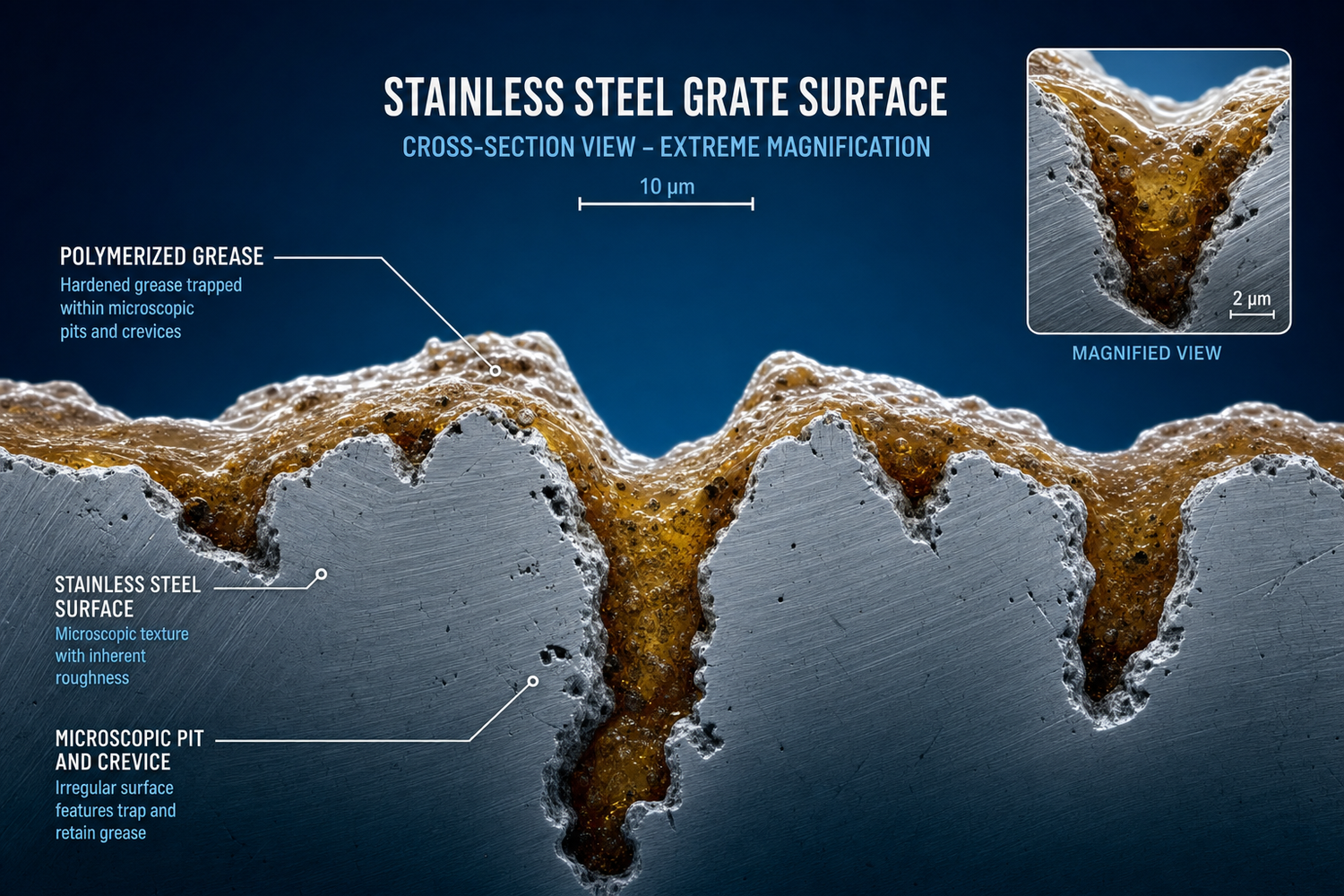
Pick up the grates from your grill and run a fingernail across them. They feel smooth. Under a microscope they are not. Even a high-grade polished stainless surface has Ra (average surface roughness) values of 0.4 to 3.2 microns -- microscopic peaks and valleys etched into the metal during forging, casting, and finishing (VINMAY surface roughness reference). Cast iron is roughly an order of magnitude rougher. Your grates are not smooth. They are a landscape of canyons, and a single molecule of cooking oil is about a nanometer long. The math is not on your side.
What Polymerization Actually Does to Steel
Here is what most weekend grillers do not know: the brown-black layer that builds up on your grates is not just dirty oil. It is a chemically transformed material that did not exist last summer. It is a polymer -- specifically, a cross-linked network of oxidized fatty acid molecules covalently bonded to the iron oxide on your steel.
Cooking oil is mostly triglycerides -- three fatty acid chains attached to a glycerol backbone. At grilling temperatures (typically 400 to 700 degrees Fahrenheit at the grate), those triglycerides break down. The fatty acids release. Some of them oxidize, picking up oxygen atoms and forming reactive intermediates called peroxides and aldehydes. Those reactive molecules then cross-link with each other, forming long, branching polymer chains. The chains tangle, harden, and bond to whatever surface they cooled on (lipid oxidation chemistry overview).
That hardened polymer is what every grill brush in your garage has been fighting. It is also, chemically, the same material as the seasoned coating on a cast iron pan -- just less controlled, deposited at random across whatever surface caught the splatter.

The Grease on Your Grates Is Not Stuck. It Is Bonded.
The grease on your grates is not stuck there. It is bonded. Above roughly 350 degrees Fahrenheit, unsaturated fats and triglycerides undergo a chemistry called autoxidative polymerization. The oil molecules break down, release reactive free radicals, and cross-link with each other to form a tough, plastic-like polymer network. Some of those radicals do not stop at each other -- they bond covalently to iron oxide (Fe2O3) sites on the metal itself, anchoring the new polymer film directly to your grate (Cast iron seasoning chemistry).
This is not a stain. It is not a residue. It is a new chemical compound that is now physically part of your grill, hooked into the iron crystal structure at the atomic level. You cannot wash that off. You cannot wipe that off. The only way to remove it without solvents is mechanical abrasion -- which is why you reach for a wire brush. And the only reason a wire brush works is that it strips off the top layer of metal along with the bonded polymer.
Why Burn-Off Cycles Make It Worse
The conventional wisdom is that you should burn off your grates at high heat to clean them. The chemistry says otherwise. Heat is what created the polymer in the first place. Adding more heat after the polymer is already bonded does two things: it pyrolyzes the carbon in the polymer (turning the brown polymer into a black, more graphitic char), and it deepens the bonding with the underlying metal.
What burn-off cycles actually do is convert a sticky, somewhat-removable polymer into a hardened carbon film that is even more strongly anchored to the iron oxide layer beneath it (pyrolysis overview). That is why grills cleaned with the burn-off-and-brush method develop progressively darker, harder-to-remove buildup over each season, not less.
This is why grates get worse over a season, not better. Every burn-off cycle thickens the patina, deepens the pores, and gives the next round of grease more places to grip.

The Sol-Gel Ceramic Approach
The chemistry-correct way to break this cycle is not to clean harder. It is to change the surface so the polymer cannot bond to it in the first place. That requires filling the microscopic peaks and valleys with something the fatty acid radicals cannot covalently attach to, and that something has to survive the temperatures and thermal cycling of an active grill.
Sol-gel-derived ceramic coatings do this. They start as a liquid suspension of silica precursors that flow into surface roughness, then chemically cure into a dense glass-like film bonded to the substrate. The cured ceramic has no free iron oxide sites at the surface, so the polymerization reaction has nothing to anchor with. The polymer can still form -- the chemistry of cooking oil at high temperature is unavoidable -- but the cross-linked film now sits on top of the coating with nothing to grip. It releases cleanly when cold.
This is what Grillacoat actually does, mechanically -- on the lid, hood, firebox exterior, side panels, and the rest of your grill's non-cooking metal that lives through the same heat cycles. It is not a slippery layer or a water-repelling treatment. It is a sol-gel-derived ceramic that fills those same microscopic valleys in your grill's exterior steel, then cures into a dense, low-surface-energy silica network. Polymerization still happens above 350 degrees on any hot metal -- that is unavoidable thermodynamics. But on a coated surface, the polymer film no longer has iron oxide to bond to and no pores to anchor in. It sits, it cools, it scrapes off.
Important: Grillacoat is engineered for the surfaces around your food, not the cooking grates themselves. Seasoning and a proper scraper handle the grates. Grillacoat handles every other surface that grease, smoke, and weather attack -- the parts that determine whether your grill still looks new in five years.
What This Means for Your Cleaning Routine
The point is not that your grates are defective. They are not. They are doing what every commercial stainless and cast iron surface does. The point is that the same chemistry is attacking every other piece of metal on your grill -- the lid liner, the firebox exterior, the side panels, the hardware -- and on those surfaces, the cleaning struggle is not a brushing problem. It is a surface-chemistry problem with a known solution that does not involve more elbow grease.
If you want the cleanup on every non-cooking surface of your grill to come down to a wipe instead of a scrub, treat the metal once with Grillacoat. The chemistry does not care about your weekend.