
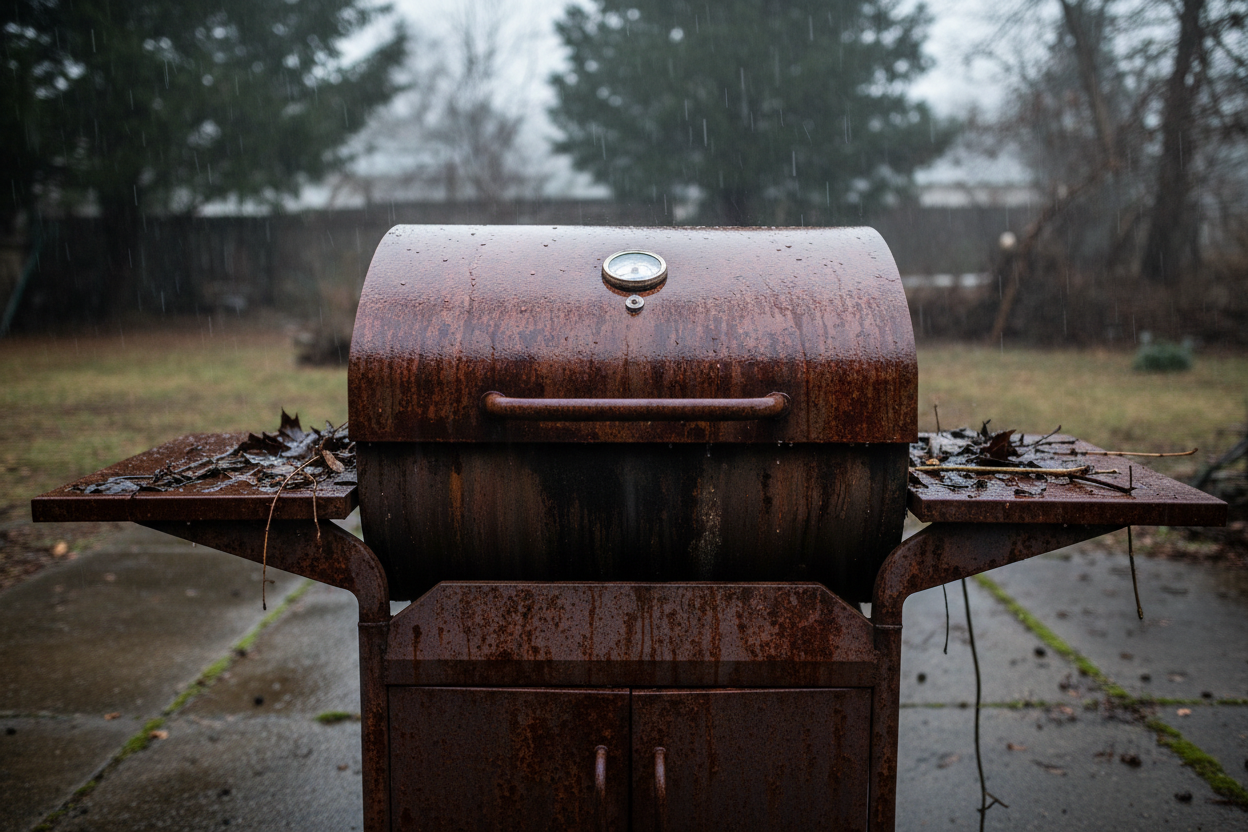
Go look at your grill. Really look at it. If you bought it during the great pandemic backyard rush of 2020 or 2021, there's a good chance you're staring at flaking paint, orange rust creeping up the legs, and a lid that's seen better days. You're not imagining it — and it's not just because you've been grilling a lot. Your grill is dying, and it probably started the moment you left it outside.
It's not the grill's fault. It's the elements. And if you're shopping for a new grill this spring, you're about to make the exact same mistake unless you understand what actually kills a grill — and how to stop it before it starts.
The Pandemic Grill Boom Was Real — and the Clock Is Running Out
The numbers back this up. According to NPD Group data cited by CNBC, more than 21 million grills and smokers were purchased by U.S. consumers between July 2020 and mid-2022. The outdoor cooking industry hit $6.1 billion in sales in 2021 alone — a 14% jump from the year before. Grill ownership climbed from 64% of U.S. households in 2019 to 70–80% by 2021, the highest levels ever recorded, according to the Hearth, Patio & Barbecue Association (HPBA).
That wave of pandemic grills is now five to six years old. Here's what the grill manufacturers won't put in their brochures: mid-range gas grills typically last 5–7 years with only moderate care. Leave one outside without real protection and that number gets cut in half. The replacement cycle is coming.

Why Grills Really Die (It's Not What You Think)
Most people assume their grill fell apart because it was cheap. Sometimes that's true. But even a solid $400–$600 grill deteriorates fast when it's left exposed to the elements year-round with nothing between its exterior and the weather.
Here's what's actually happening:
Moisture is the number one killer. Every rain shower, morning dew, and humid summer night creates the conditions for oxidation. Once moisture finds a scratch or a seam — and it always does — rust gets a foothold and spreads, often invisibly, until the damage is already deep.
Grease accelerates the damage. Grease splattered on the exterior attracts and holds moisture against the metal, speeding up corrosion. Combined with heat cycling — the constant expansion and contraction as the grill heats and cools — the exterior coating eventually cracks, peels, and exposes bare metal to the elements.
Temperature swings break things down. Sun bakes the exterior in summer. Freezing temps contract the metal in winter. Rain, UV exposure, and temperature extremes add up to a years-long assault on unprotected steel. A grill cover helps — but it's not enough on its own.
None of this is a design flaw. It's physics. You can't stop the weather. But you can stop the weather from destroying your grill.
What Most Grill Owners Do (and Why It Falls Short)
The typical grill owner throws a cover on it, maybe wipes it down once a season, and hopes for the best. A cover is better than nothing — but it doesn't seal or protect the metal itself. Moisture still gets under it. Salt air still gets in. The exterior is still bare metal taking a beating from every season.
Some people try spray paint or generic rust-inhibitor sprays. Those chip off, aren't designed for the heat and grease environment of a grill, and need constant reapplication. It's a band-aid, not a fix. The right answer is a purpose-built protective coating applied directly to the exterior metal — one that bonds to the surface, repels grease, blocks moisture, and stands up to weather year after year.

Protect Your Next Grill From Day One
The absolute best time to protect a grill is before damage starts. Not after you see rust. Not after the paint starts flaking. Day one — when the metal is clean and fresh.
Grillacoat is a ceramic protective coating built specifically for the exterior surfaces of grills, smokers, and griddles. You wipe it on in about 10 minutes. It bonds to the metal, creating a barrier that repels grease, resists rust, and stands up to weather season after season. One application holds up through multiple seasons of cooking and weather. No repainting. No chasing rust with spray cans. No watching your investment deteriorate from the outside in.
It's 100% made in the USA, ships free, and backs every bottle with a 30-day money-back guarantee. At $119, it costs less than a single repair visit — and it starts working the day you apply it.
You already spent $300, $500, maybe $800 on your new grill. The coating that protects it costs a fraction of that and takes ten minutes.
Don't Repeat the Same Mistake Twice
Millions of Americans are heading into spring 2026 in the same position: standing next to a rusting, corroded pandemic grill, about to spend real money on a replacement. The temptation is to just buy another grill and start the cycle over.
Break the cycle. When your new grill arrives, protect it properly from day one. A cover keeps the rain off. Grillacoat keeps the rust out. Together, that's a setup that can genuinely make your grill last a lifetime.
Ready to protect your investment from Day One? Grab Grillacoat here -- free shipping, 30-day guarantee, 10 minutes to apply.