
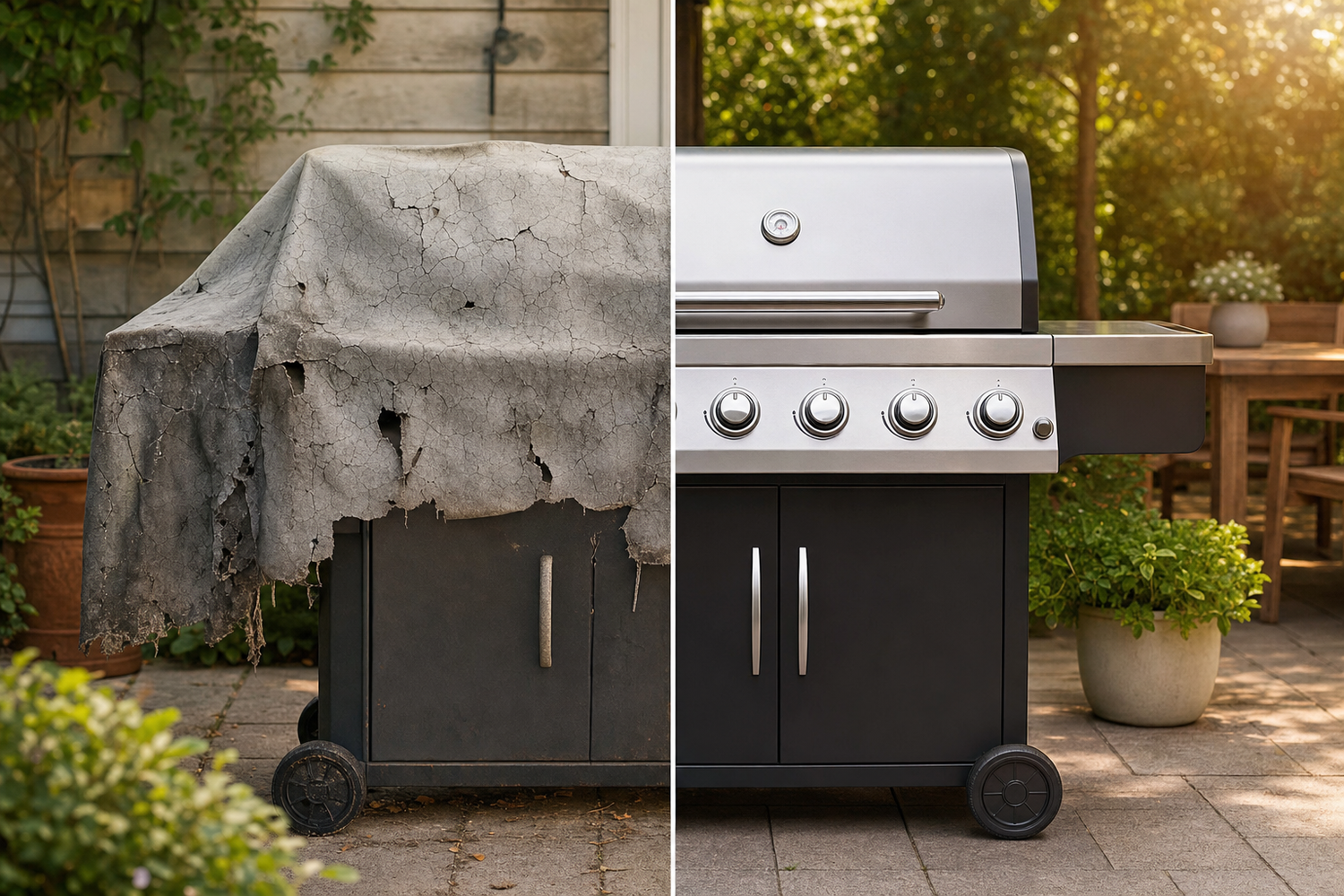
You bought a grill cover. It felt like the responsible move -- the obvious answer to the question of how you protect a $400 or $600 grill from rain, UV, and winter weather. And then, at some point in year two or three, you noticed the cover starting to crack, fade, or shed its coating. You replaced it. And the cycle started over. Most grill owners are on their second or third cover before they stop to ask why they keep buying a product that protects the cover, not the grill.

What a Grill Cover Actually Does (and Doesn't Do)
A grill cover keeps rain, bird droppings, and airborne debris off the exterior surfaces when the grill is not in use. That is a real function, and it matters. But here is what a cover does not do: it does not prevent moisture from accumulating underneath it. Covers trap condensation on humid nights. They create a microclimate under the shell where moisture lingers against metal surfaces -- the exact condition that accelerates oxidation. If your grill already has any compromised finish areas -- micro-scratches from cleaning, a chip in the powder coat, a small area of exposed metal -- moisture under the cover will find those spots and work on them every night.
A cover is also irrelevant during cook sessions, which are when grease, UV heat, and thermal cycling do the majority of finish damage. The cover comes off when the grill is in use and goes back on after. All the finish degradation happens in the window when the cover is not there.
The Cover Math Over 12 Years
According to Griller's Spot's analysis of grill cover lifespan, the average grill cover lasts 3 to 5 years under normal conditions. Budget covers may last a single season. Higher-quality covers can reach 10 years with careful maintenance, but those are the outliers.
Run the math on a 12-year grill ownership period -- which is a reasonable assumption for a mid-tier grill with basic maintenance. At 3-year replacement intervals, you buy four covers. At $40-$80 per cover for a quality model, that is $160-$320 in cover spending over the life of the grill. At 5-year intervals, you buy two to three covers: $80-$240. The cover budget over the grill's life often equals or exceeds 20-50% of the grill's original purchase price.
What the Cover Math Misses
The more important problem is not what covers cost -- it is what they fail to prevent. The finish damage that ruins a grill's appearance and accelerates structural corrosion happens primarily on the exterior surfaces during and after cook sessions: grease vapor landing on panels and bonding to powder coat, UV degrading the finish over summers, heat cycling causing micro-cracking that moisture then penetrates. A cover sitting in the garage does nothing about any of this.
Compare this to how a ceramic coating actually works. Professional auto ceramic coating applications take 3 to 5 days because paint correction labor -- removing swirl marks, oxidation, and surface defects -- dominates the time. The chemistry itself is fast. On a grill, there is no paint correction step. The surfaces are large, simple panels with no complex paint layers to correct. Application is direct: clean the surface, wipe on the coating, let it cure.
The 10-Minute Application
Grillacoat takes roughly 10 minutes per panel surface to apply. For a standard three-burner gas grill, a full exterior application -- both side panels, the hood, the front face, the shelf supports -- takes about 30 minutes start to finish. You do it once, and the ceramic bond that forms protects the surface for multiple years against grease, UV, moisture, and thermal cycling. It does not trap condensation underneath a shell because it is bonded to the surface itself. It does not peel, crack, or shed because it is not a fabric or coating sitting on top of the finish -- it is chemically bonded to the substrate.

The product bonds to powder coat, porcelain enamel, stainless steel, and cast aluminum -- the substrates used on virtually every gas, charcoal, and pellet grill exterior. It is not for cooking grates or food-contact surfaces. It is for the exterior that a cover was trying, and mostly failing, to protect.
The Real Reframe
A grill cover is not protecting your grill. It is protecting your grill when it is not in use, from a subset of the damage it faces, with a product that fails in 3-5 years and needs to be replaced. Most of the finish damage your grill accumulates happens in the window the cover cannot help with.
The math on a $199.99 two-pack of Grillacoat versus $160-$320 in covers over the same period is not even close -- and the coating protects the surfaces that actually matter, during the conditions that actually cause damage. If you have already bought the cover, keep it for debris protection between seasons. But do not confuse owning a cover with having protected your grill.