
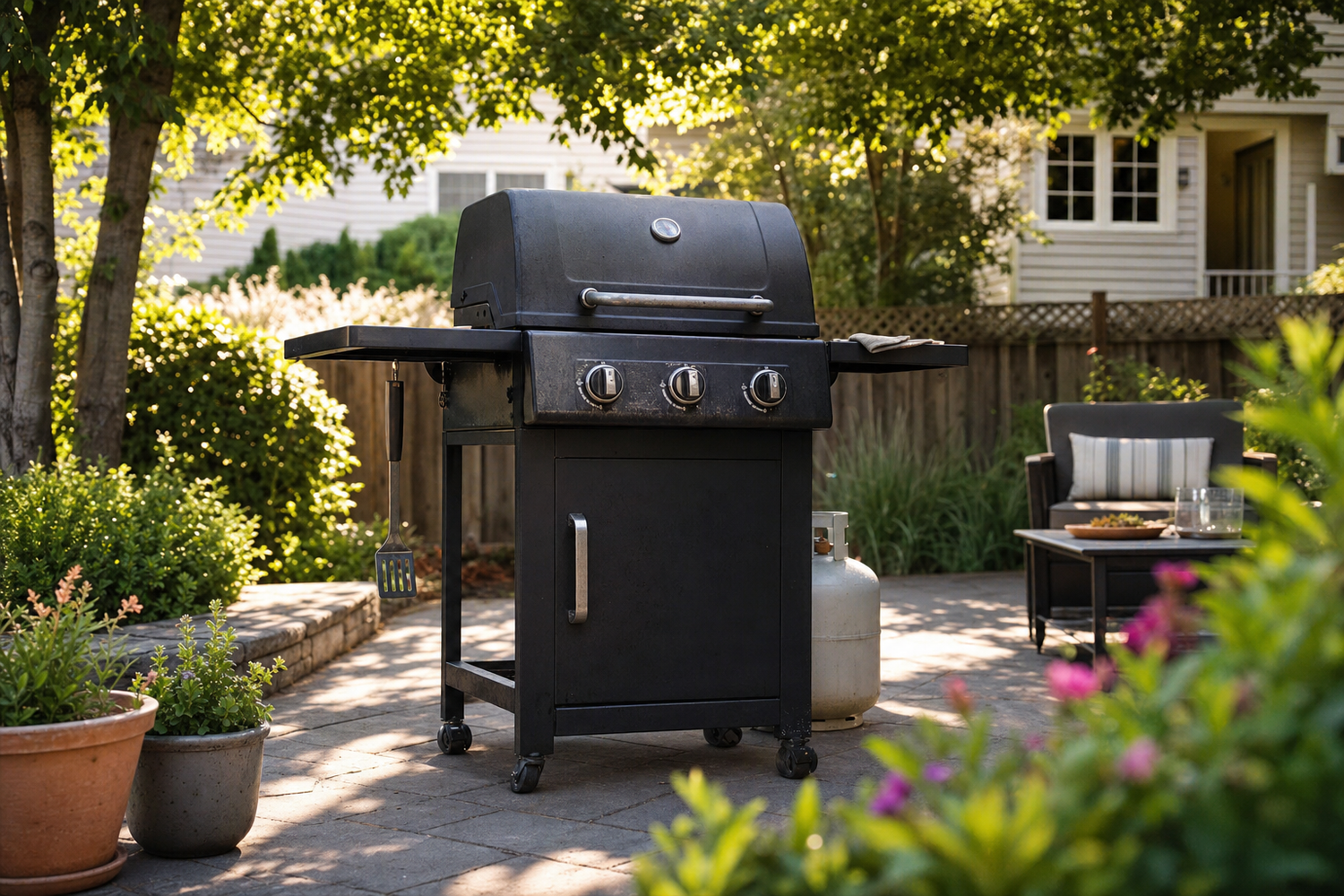
The grill industry just published the data and it tells a story most owners have already lived. According to OpenBrand's Q4 2025 outdoor cooking market report, the largest share of grill unit sales in America now happens in the $200 to $399 price tier. Not $800. Not $1,200. The volume of grills moving off shelves in this country has settled into a value-driven sweet spot well under $400.

Traeger's Q1 2026 earnings confirmed the same shift in less flattering terms. Grill revenue fell 45.4% year over year, average selling prices dropped, and the company specifically cited "mix shift toward lower priced grills" as a driver. In response, Traeger launched the Westwood line in April at a lower entry price, and rolled out the Irontop griddle series to "broaden relevance" beyond the traditional grill replacement cycle. Even the premium-pellet brand is chasing the consumer downmarket.
The Cheaper Grill Has a Cheaper Build
This matters because the $299 grill that has become the American norm is not a smaller version of the $1,200 grill of 2015. It is a fundamentally different piece of equipment.
The $1,200 grill from a decade ago typically came with thick-gauge stainless steel, heavy cast aluminum end caps, premium porcelain enamel inside the lid, and a powder coat thick enough to survive years of UV. The $299 grill that dominates today's market is engineered to hit a price -- which means thinner steel that flexes and chips, lower-grade enamel that crazes after two seasons, and powder coat that fades visibly within 18 months of patio exposure.
None of that makes the cheap grill a bad cook. Most $299 grills produce food indistinguishable from $1,200 grills for the first few seasons. The cooking performance is fine. What ages prematurely is everything around the cook -- the lid, the cabinet, the shelves, the handles. The surfaces buyers see every time they walk onto the patio.
The Replacement Cycle Got Faster Without Anyone Noticing
The traditional grill replacement cycle was 8 to 12 years. That math worked because the premium grill held its finish long enough to remain proudly displayed in year nine. Most owners replaced their grills not because they failed mechanically but because they finally looked bad enough to embarrass the host.
The $299 grill compresses that timeline. The burners might run for 8 years, but the powder coat is chalking by year three. The lid is faded by year four. The side shelves have grease-baked stains that no degreaser pulls out. The grill is functional and ugly -- and the moment the patio crowd notices, the owner is back at Home Depot.

This is exactly the dynamic Traeger called out when it acknowledged a need to "broaden category participation" beyond replacement cycles. They are not wrong about the demographic shift. They are responding to the fact that today's value-tier grill owner replaces equipment based on appearance, not mechanical failure.
The Cheapest Protection Is the Most Disproportionate
Here is where the math gets interesting. Protecting a $1,200 grill is a no-brainer -- 10% of equipment value spent on protection extends the life of a serious investment. Protecting a $299 grill looks less obvious because the equipment costs less. It is actually more important. The percentage may be similar, but the alternative cost is replacement of an entire grill after 3-4 years instead of 10.
That is the case for Grillacoat on a value-tier grill specifically. A $119 single bottle or a $199.99 two-pack of ceramic coating, applied in one afternoon to the lid, side panels, shelves, and cabinet doors, bonds to the exact finishes -- powder coat, porcelain enamel, stainless steel, cast aluminum -- that age fastest on a budget grill. The coating itself does not care whether the grill cost $299 or $2,999. It bonds to the metal the same way. What changes is the economics on the buyer's side: protect the $299 grill, and you avoid the next $299 grill, and the one after that.
What the Industry Is Telling You
When Traeger pivots to lower entry prices and the largest unit-sales tier sits at $200-$399, the message is unambiguous. Americans are not buying fewer grills. They are buying cheaper grills more often. Manufacturers are responding by building down to the price point. The cosmetic and finish quality of mass-market grills is going to keep declining, not improve.
The owners who quietly opt out of the faster replacement cycle are the ones who treat their $299 grill the way the previous generation treated a $1,200 grill -- coat it once, maintain it lightly, replace it on their own timeline instead of when the lid finally looks bad enough to be embarrassing. A two-pack of Grillacoat on a budget-tier grill is not premium overspending. It is the math correction the industry is quietly forcing every value-conscious buyer to make. Head over to Grillacoat's product page if your grill cost less than $400 and you want it to outlive the trend.