
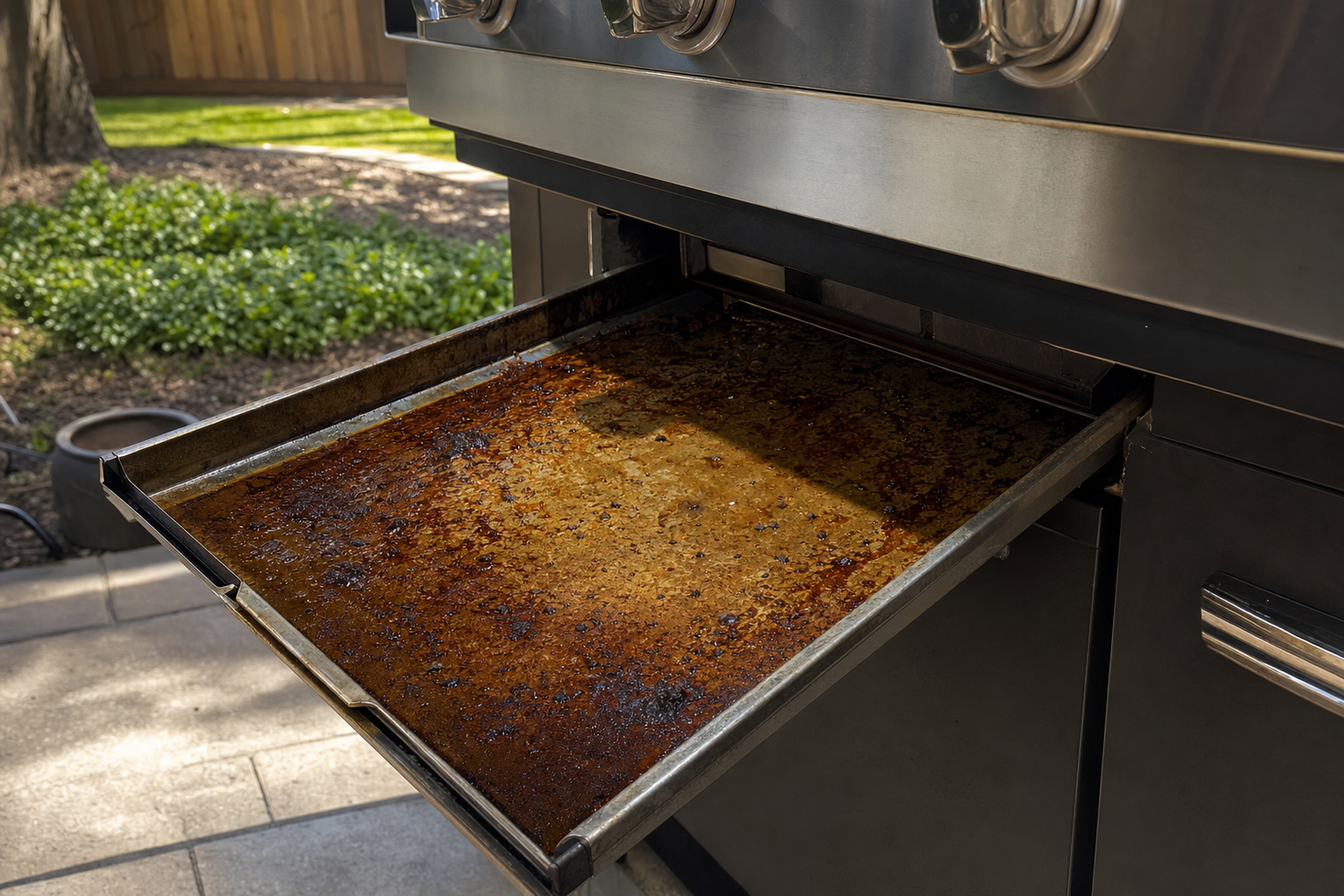
One in five grill fires in the United States is caused by a grill that was not cleaned. That is not a fringe statistic buried in a footnote -- it is the single leading contributing factor to grill ignitions identified by NFPA research, based on 2020-2024 annual averages across more than 12,000 home grill fires per year. The grease tray is not a passive component that occasionally needs attention. It is a secondary fuel source that is quietly accumulating every time you cook.

Why Grease Fires Are Not Accidents
Most grill fires that originate in the grease tray follow a predictable sequence. Grease drips from cooking food into the tray below the grates. Over multiple cook sessions, that grease accumulates and begins to thicken into a carbonized layer. The grill reaches high temperatures -- above 500 degrees Fahrenheit with the lid closed in normal operation -- and the accumulated grease ignites. The fire is not sparked by a malfunction. It is the inevitable outcome of a fuel source being heated past its ignition point.
This is not an edge case or a rookie mistake. Travelers Insurance's analysis of gas grill fire causes describes grease trap accumulation as "a secondary fuel source quietly accumulating" that "doesn't take too many barbecues" to become a dangerous condition. The mechanism is the same whether you are grilling lean chicken or fatty brisket -- it is a matter of how much accumulates and how quickly.
The Scheduled Cleaning Approach
The most effective approach to grease tray management is a scheduled routine that does not depend on visual inspection. Many grills develop carbonized grease buildup that is not visually obvious until it has already accumulated to dangerous levels. Grease that has been repeatedly heated and cooled turns dark and blends visually with the tray surface. If you wait until the tray looks dirty, you are already behind.
A scheduled approach means cleaning after every 3 to 5 uses regardless of appearance. Most residential grillers who cook two to three times per week should be cleaning the grease tray every two weeks at minimum. Those who cook more frequently -- daily or near-daily use -- should clean weekly. The threshold that matters is not visual; it is temporal and use-based.
What to Use and What Not to Use
For most grease trays, hot water and dish soap applied with a stiff brush is sufficient. Degreasers accelerate the process on heavily carbonized trays. Weber's official cleaning guide recommends their Q Grill Cleaner for grease tray maintenance and suggests soaking severely fouled trays in hot soapy water before scrubbing. If the tray has a disposable foil liner, replacement is straightforward -- the liner is pulled and discarded, and a new one is inserted.
Do not use steel wool or abrasive metal pads on porcelain-coated or non-stick trays. These surfaces scratch easily and once the coating is compromised, grease adheres more aggressively to the exposed material underneath. For coated surfaces, use a plastic scraper and a soft bristle brush.
Disposable Liners vs. Permanent Trays
Most modern gas grills use one of two grease tray configurations: a permanent metal tray that is cleaned in place or removed for washing, or a catchment system that uses a small disposable aluminum drip pan. The disposable liner approach is effectively zero-maintenance if the liners are actually replaced -- the problem is that most users replace them far too infrequently.
A disposable liner should be replaced every 3 to 5 uses regardless of how full it appears. The liner collects both liquid grease and carbonized particulate. As the liner ages, the residue dries and becomes increasingly combustible. An old liner with dried carbon residue is more dangerous than a newer liner that appears fuller, because the liquid grease in the newer liner has a higher ignition threshold than the dry carbonized material in the old one.
Grease Channel and Drain Maintenance
The grease tray does not function in isolation. Most gas grill designs route grease from the cooking area through channels, baffles, or deflector plates before it reaches the tray. These channels accumulate grease independently of the tray itself and are routinely missed during standard cleaning. Napoleon's gas grill cleaning guide specifically identifies grease channels as a secondary accumulation point that requires direct attention and recommends cleaning them with a narrow brush or pipe cleaner during every deep clean cycle.
The drain tube or port -- if your grill has one -- is the other frequently missed component. Grease that pools in the channel and does not drain efficiently will back up into the cooking area. Inspect the drain path every time you clean the tray and clear any blockage with a bottle brush.
Grill Mat and Tray Positioning
If your grill sits on a deck or patio surface, a grill mat underneath catches any overflow from the drip system and protects the surface beneath. More importantly, the mat is a visible indicator of how much grease is actually escaping your tray system. If you notice significant pooling on the mat, your tray is overfull or your drain is blocked -- the mat is not solving the problem, it is revealing it.
Tray positioning matters in a different way. Grills must be sitting on a level surface for the drip system to function as designed. A grill that tilts to the left will pool grease on the left side of the internal channel, potentially overflowing the tray on that side before the rest of the tray is full. If you clean by eye and your grill is not level, you may be misreading how full the tray actually is.
Grease Tray Replacement
Permanent grease trays are not indefinite components. Most are stamped steel and begin to corrode at seams and corners after extended exposure to grease, heat cycling, and cleaning chemicals. Inspect your tray for rust, pitting, or structural deformation annually. A tray with compromised integrity can fail -- developing cracks or holes that allow grease to bypass the collection system entirely and pool inside the firebox. Replacement trays are available for most major grill brands and are inexpensive compared to the alternative.
Why This Is a Routine, Not a Project
The core problem with grease tray maintenance is that it is treated as a seasonal task rather than a routine one. Most grillers deep-clean their equipment at the start of grilling season in the spring. The grease tray, if cleaned at all, is cleaned once a year. For a grill used twice a week from May through September, that is roughly 40 cook sessions between cleanings. The NFPA data on grill fires reflects this pattern directly -- the peak period for grill fires is late spring and early summer, when grills that sat all winter are brought out and fired up without any cleaning, and when the first cook sessions of the season heat a tray that has been sitting with accumulated residue since the previous fall.
Changing this outcome requires treating grease tray cleaning the same way you treat the grill grates -- as something you do routinely, not annually. The 10 minutes required to remove, empty, wash, and replace the grease tray every few cooks is the entire cost of fire prevention. There is no special equipment required. There is no complex technique. It is a routine that eliminates the leading cause of grill fires, and the only reason most people do not do it is that nobody told them it mattered this much.