
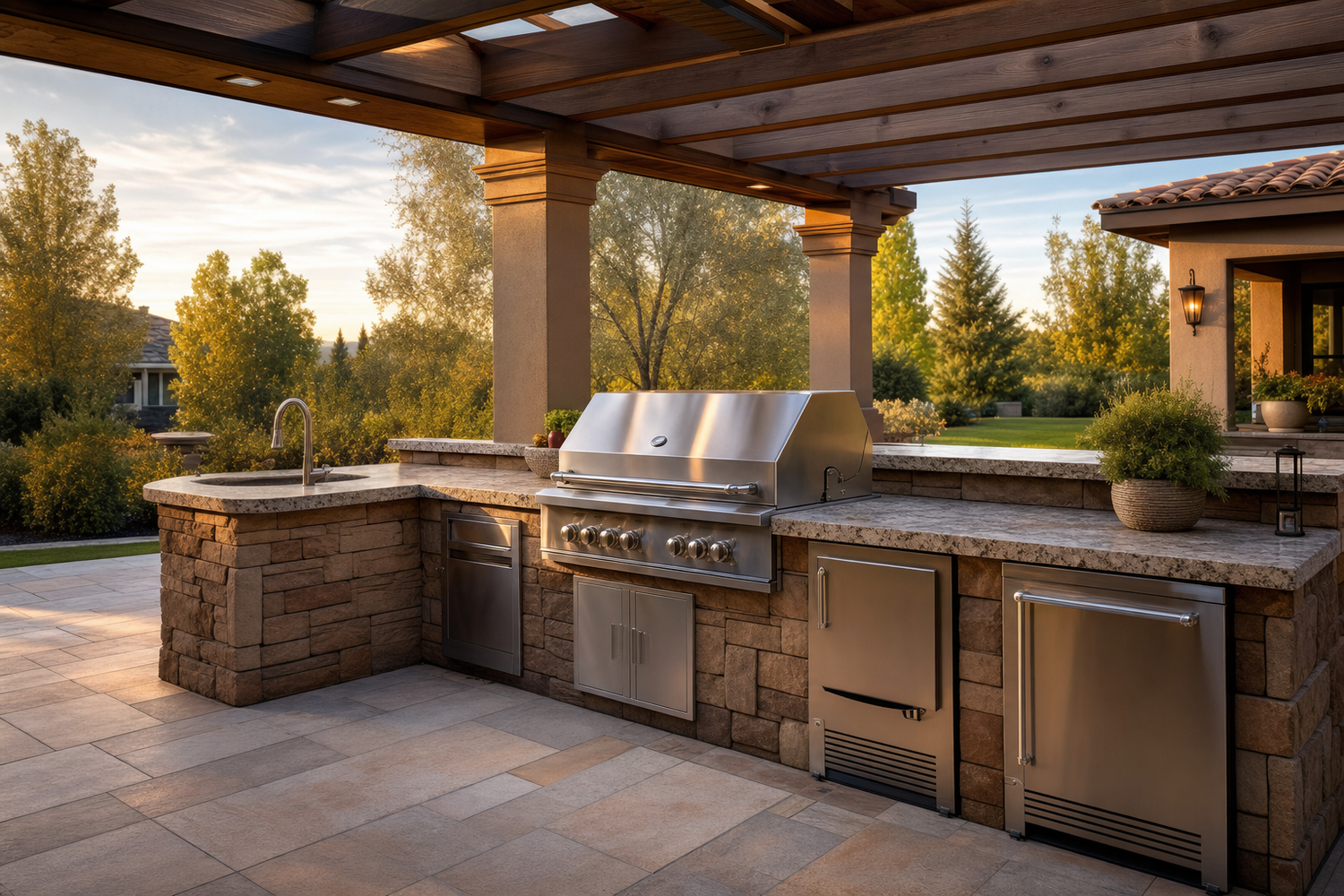
An in-ground swimming pool returns as little as 7% of its cost at resale. A finished basement might return 70%. But an outdoor kitchen -- according to multiple contractor and real estate sources -- returns somewhere between 55% and 200% of what you paid to build it. That is an unusually wide range, and the gap between the low end and the high end is not determined by which appliances you installed. It is determined by how the kitchen looks when the house goes on the market.

What the Numbers Actually Say
According to Werever's outdoor kitchen value analysis, ROI estimates for outdoor kitchens range from 55% to 200% depending on the property, market, and condition. For Texas homeowners specifically, PBA Southwest reports a typical return of 55-80% on builds ranging from $8,000 for basic setups to $12,000-$18,000 for mid-range kitchens with built-in appliances and stone finishes. High-end builds exceed $20,000.
On a $15,000 mid-range outdoor kitchen, a 55% return means $8,250 recovered at sale. An 80% return means $12,000. That $3,750 swing does not come from whether you installed a Lynx grill or a DCS -- both are high-quality equipment that buyers recognize. It comes from whether the finish condition of the kitchen reads as maintained or neglected when buyers walk through the property.
Why Finish Condition Drives ROI
Buyers touring a home do not bring a contractor. They bring their eyes. A kitchen with stained grout, oxidized stainless panels, and a grill with visible rust reads as a maintenance problem -- and maintenance problems discount property values. A kitchen where every surface is clean, the steel is polished, the grout is sealed, and the grill operates visibly correctly reads as an asset. The mental math buyers do at that moment is not "what did this cost" -- it is "what will I have to spend to fix it." If the answer is nothing, they pay full value or above. If the answer is uncertain, they discount.
This is why the ROI range is so wide. A $15,000 outdoor kitchen in excellent maintained condition in a strong market can genuinely return $20,000-$30,000 in added resale value. The same kitchen, neglected, returns $8,000 -- and the $7,000 gap is not inflation or market timing. It is the cost of skipped maintenance made visible to every buyer who walks through.
The Three Surface Categories That Matter at Resale
An outdoor kitchen has three surface types that buyers assess in the first thirty seconds of seeing it. Each requires a different maintenance approach, and each contributes independently to the impression that drives offer price.
Stainless Steel Surfaces
Stainless steel is the dominant material in outdoor kitchen appliances -- grill hoods, side burners, refrigerator fronts, access doors, and drawer faces. When properly maintained, stainless reads as professional-grade and premium. When neglected, it develops surface oxidation (rust hazing), water spots, fingerprint patina, and in coastal areas, pitting corrosion that is not reversible.
The maintenance reality: standard 304-grade stainless used in quality outdoor appliances is corrosion-resistant, not corrosion-proof. The chromium oxide layer that prevents rust requires the surface to remain clean and unscratched. Grease deposits, chloride exposure (salt air, pool chemicals, fertilizers), and abrasive cleaning all degrade that protective layer. Once degraded, rust forms and spreads.
For resale preparation, stainless surfaces need to be assessed in order of severity. Light surface oxidation and hazing can be reversed with a stainless-specific cleaner and a fine scotch-brite pad, always working with the grain. Water spots and fingerprints come off with a quality stainless polish. Deep pitting -- visible cratered corrosion -- cannot be reversed and may require panel replacement before listing.
The ongoing maintenance that prevents resale remediation: wipe stainless surfaces after each cook session to prevent grease from bonding, clean with a dedicated stainless cleaner monthly, apply a stainless protectant or wax two to four times per year, and cover the kitchen or store removable appliances during extended non-use periods, especially in winter or during storm seasons.
Stone and Masonry Surfaces
Countertops (granite, concrete, tile), backsplash, the structural surround (stone veneer, block, stucco), and any decorative masonry elements all require specific maintenance to remain buyer-presentable.
Granite countertops are the most common outdoor kitchen countertop material in the mid-to-high-end segment. Granite is porous and requires sealing to resist staining from grease, food acids, and moisture. An unsealed or poorly sealed granite countertop in an outdoor kitchen will show staining, efflorescence (white mineral deposits), and potentially freeze-thaw damage in cold climates. Countertop Guides recommends sealing outdoor granite annually, more frequently in high-use kitchens or in regions with significant rainfall or temperature swings.
Stone veneer and structural masonry: the mortar joints are the vulnerable point. Cracked or missing mortar allows moisture infiltration, which leads to spalling, efflorescence, and structural instability. Buyers who see cracked mortar joints -- particularly at the base of the structure where water accumulates -- interpret it as a structural issue requiring significant remediation. Repointing mortar joints before listing eliminates that concern entirely and costs a fraction of what buyers will discount for it.
Grout in tile surfaces stains over time from grease, food, and environmental deposits. Grout cleaning and resealing is a half-day project that transforms the visual impression of a tile-surfaced kitchen.
The Grill and Cooking Equipment
The grill is the centerpiece of the outdoor kitchen. Buyers who are cooking enthusiasts -- and those buyers exist in every market -- will open the lid and assess the interior condition. What they find communicates everything about how the property has been maintained.
A clean, well-maintained grill interior -- brushed grates, clean drip tray, no carbon buildup on the burner covers, functioning ignition -- signals a maintained property. A grill interior with caked carbon, pooled grease, corroded grates, and a drip tray that hasn't been emptied in years signals a neglected one.
Pre-listing grill restoration for ROI purposes involves: a full deep clean of the interior, assessment of igniter function (igniters are inexpensive to replace and a dead igniter is a red flag to buyers), replacement of any visibly corroded grates or burner covers, and cleaning of the exterior to match the stainless maintenance standards above.
Seasonal Maintenance as ROI Protection
The highest-ROI maintenance strategy is not a pre-listing push -- it is a consistent seasonal routine that keeps the kitchen in the condition that commands maximum resale value year-round. Buyers can tell the difference between a kitchen that has been maintained over time and one that was hastily cleaned before listing. The material difference shows in grout condition, in the depth of any corrosion, in the grill's interior, and in whether protective coatings are fresh or overdue.
A four-season maintenance routine for ROI protection:
Spring activation: Deep clean all appliances, reseal stone countertops, inspect and repoint any mortar joints that showed freeze-thaw movement, polish all stainless surfaces, test all igniters and burners, replace drip tray liners.
Monthly in-season: After high-use periods (holiday weekends, frequent entertaining), clean grill interior, wipe stainless surfaces, check grout and caulk for early cracking, empty drip tray.
Fall shutdown: Full deep clean of all appliances, apply stainless protectant, cover or store any removable components, inspect and address any masonry damage before freeze season.
Mid-winter check: In climates with freeze-thaw cycles, inspect masonry for new cracking and address with appropriate fillers before spring.
The Products That Make Maintenance Practical
The barrier to consistent outdoor kitchen maintenance is usually not cost or knowledge -- it is friction. If the cleaning products are stored near the kitchen, if the process is fast and the results are visible, maintenance happens. If it requires a trip to the garage and an hour of effort for a result that looks the same as before, it doesn't.
Effective outdoor kitchen maintenance requires three categories of product:
Grill cleaning: A quality grill brush for routine post-cook maintenance, a degreaser for monthly deep cleaning of the interior, and grill grate cleaner for periodic soak-and-scrub sessions. Grillaholics produces a complete line of grill cleaning tools that cover this full range -- the Heavy Duty Grill Brush for routine maintenance, a separate degreaser for interior cleaning, and replacement grate cleaning solutions for deep-clean sessions.
Stainless care: A dedicated stainless cleaner and polish that removes oxidation, water spots, and grease while restoring the protective finish. Avoid generic household cleaners that contain chlorine bleach -- they accelerate stainless corrosion rather than preventing it.
Stone and masonry care: A pH-neutral stone cleaner for routine surface maintenance, a dedicated granite sealer for annual resealing, and a grout cleaner and sealer for tile surfaces. These are not specialty products -- they are available at any home improvement store and require an hour of application time once per year.
What This Means For Your Specific Kitchen
If you are five or more years from selling, the ROI math on maintenance is simple: the cost of a consistent seasonal maintenance routine is a few hundred dollars per year in products and a few hours of time. The return on that investment, in terms of preserved resale value, is measured in thousands. An outdoor kitchen that enters the market in excellent condition after ten years of consistent maintenance will command 40-60% more at resale than the identical kitchen that enters the market neglected.
If you are within two years of selling, the priority list is: (1) address any irreversible damage first (deep pitting on stainless, structural masonry failures, dead appliances), (2) deep clean everything, (3) reseal stone surfaces, (4) restore stainless to its best achievable condition, (5) ensure all appliances function correctly. This is the sequence that closes the gap between a 55% return and an 80% or higher return on a kitchen that cost you $15,000 to build.
The 55-200% ROI range is not a mystery. It is the documented financial outcome of a decision made in the months and years before the for-sale sign goes up: whether to maintain the kitchen at a level that reads as an asset, or to let it decline to a level that reads as a liability. Maintenance is the variable. Consistent, product-supported maintenance is the strategy that puts you at the top of that range.