
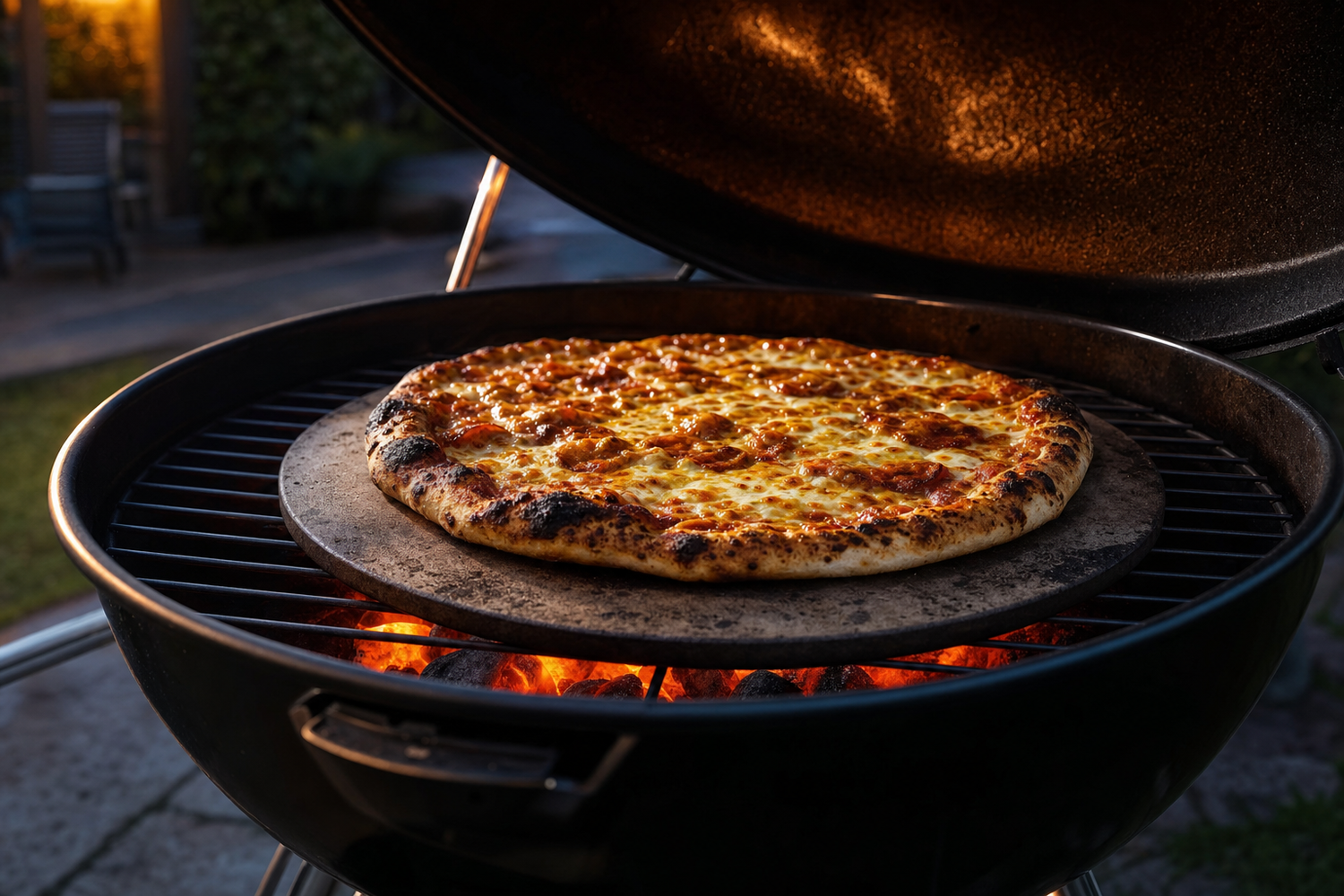
The outdoor pizza oven market has exploded. Ooni, Gozney, and Solo Stove have built a category that did not meaningfully exist five years ago. The pitch is compelling: a dedicated high-temperature oven that reaches 900+ degrees and produces genuine Neapolitan pizza in 90 seconds. The marketing is excellent. The problem is that most buyers already own something that achieves the same result at the same temperatures with the right setup -- a standard kettle grill or kamado sitting in the backyard.
Outdoor pizza is not an equipment problem. It is a setup problem.

What Temperature Actually Does to Pizza
The reason professional pizza is different from home pizza is not the recipe or the sauce -- it is the temperature. Coal-fired New York pizza ovens run at 800 to 900 degrees. Neapolitan pizza cooks in 90 seconds at those temperatures because the extreme heat simultaneously chars the crust exterior, cooks the interior, and sets the cheese before any component dries out or overcooks. That heat is what creates the leopard spotting, the airy cornicione, and the texture that makes great pizza immediately recognizable.
A standard home oven maxes out at 500 to 550 degrees. At that temperature, pizza takes 8 to 12 minutes, and the longer cook time dries out the dough before the crust achieves proper char. This is why the gap between home pizza and restaurant pizza can feel enormous even when the ingredients are identical.
Dedicated pizza ovens like the Ooni Karu and Gozney Arc can reach 950 degrees and close that gap significantly. But according to Meatwave's KettlePizza guide, a standard 22-inch Weber kettle with a pizza stone and proper charcoal arrangement can regularly reach 700 to 750 degrees at stone level -- more than enough to produce a leopard-spotted Neapolitan-style crust in under 3 minutes.
The Temperature Gap Is Smaller Than the Marketing Suggests
The dedicated pizza oven pitch relies on a comparison to your home kitchen oven, not to a properly configured grill. A $500 Ooni Karu versus a $500 home oven is a compelling comparison. A $500 Ooni Karu versus a kettle grill you already own that can reach 700 degrees is a much less compelling comparison.
The practical difference between 700 and 900 degrees for pizza is real but smaller than expected. At 700 degrees, a Neapolitan-style pizza cooks in approximately 2 to 3 minutes instead of 90 seconds. The crust still achieves char and leopard spotting. The cornicione still develops properly. The cheese still sets without burning. The result is not identical to a 900-degree cook, but it is far closer to professional-quality pizza than anything a home oven can produce.
How to Hit 700 Degrees on a Kettle Grill
The key variables are charcoal quantity, placement, and preheat time. Standard kettle pizza technique as described by Serious Eats involves lighting a full chimney of charcoal -- approximately 100 briquettes or equivalent lump -- and arranging it in a ring around the perimeter of the charcoal grate. This creates an indirect heat environment with radiant heat from the sides and reflected heat from the dome. The pizza stone sits in the center of the cooking grate, away from direct contact with the coals.
Preheat is critical. The stone must be in the grill during the entire preheat process, which takes 45 to 60 minutes with the lid closed and the vents fully open. Placing a cold stone in a hot grill causes thermal shock and potential cracking. An improperly preheated stone also fails to transfer bottom heat correctly, resulting in an undercooked crust bottom even when the top is properly charred.
Vent position controls temperature. Fully open vents maximize airflow and push the temperature toward the upper range. Partially closed vents drop the temperature but also reduce the intensity of the cook. For pizza, you want maximum temperature -- both vents fully open for the entire cook.
Where a Dedicated Pizza Oven Wins
The kettle grill approach has real limitations. Charcoal temperature drops over time, which means you can typically cook 4 to 6 pizzas at full temperature before the heat diminishes enough to affect cook quality. Adding more charcoal mid-session is possible but requires care and interrupts cooking. A gas-powered pizza oven like the Ooni Koda maintains consistent temperature across an entire session without fuel management.
The other genuine advantage of a dedicated pizza oven is the cooking chamber geometry. Purpose-built pizza ovens have low ceilings that concentrate radiant heat directly onto the pizza from above at close range. A kettle grill's dome is higher and less focused. The result is that dedicated ovens produce more even top-heat distribution and more consistent results across the pizza surface, while a kettle grill can produce hot spots that require rotating the pizza every 30 to 45 seconds.
For high-volume home pizza production -- 10 or more pizzas at a single session -- a dedicated pizza oven is the better tool. For occasional pizza alongside other grilling, the kettle approach is technically and economically sufficient.
Kamado Grills at High Temperature
Kamado grills like the Big Green Egg and Kamado Joe have a specific advantage for pizza over standard kettle grills: thermal mass. The thick ceramic walls absorb and radiate heat in a way that creates a more oven-like environment inside the cooking chamber. A kamado preheated to 700 degrees holds that temperature more consistently and recovers faster after the lid is opened than a thin-walled steel kettle grill.
The standard kamado pizza setup uses the deflector plates to create indirect heat and the pizza stone on the upper rack. Kamado Joe's pizza guide targets 500 to 600 degrees for their recommended setup, but the grill is capable of significantly higher temperatures if the vents are opened fully and the charcoal load is increased. Many kamado pizza cooks target 650 to 750 degrees for Neapolitan-style results.
The Actual Decision Framework
If you already own a kettle grill or kamado, a dedicated pizza oven is an optional upgrade that improves convenience and upper-end temperature rather than enabling something fundamentally impossible without it. The pizza you can produce on a properly configured kettle grill with a $40 pizza stone is better than the pizza most people produce on a $500 standalone pizza oven because the setup variables on the grill are well-documented and the results are predictable.
If you do not own any outdoor cooking equipment and pizza is the primary use case, a dedicated pizza oven makes more sense than buying a grill and learning the pizza-specific configuration. The Ooni and Gozney products are optimized for one thing and do that one thing with minimal setup friction.
If you own a grill and are primarily motivated by the novelty of a pizza oven rather than a genuine gap in what your current equipment can produce, the honest answer is that a good pizza stone and a full chimney of charcoal will close most of that gap for about $40.