
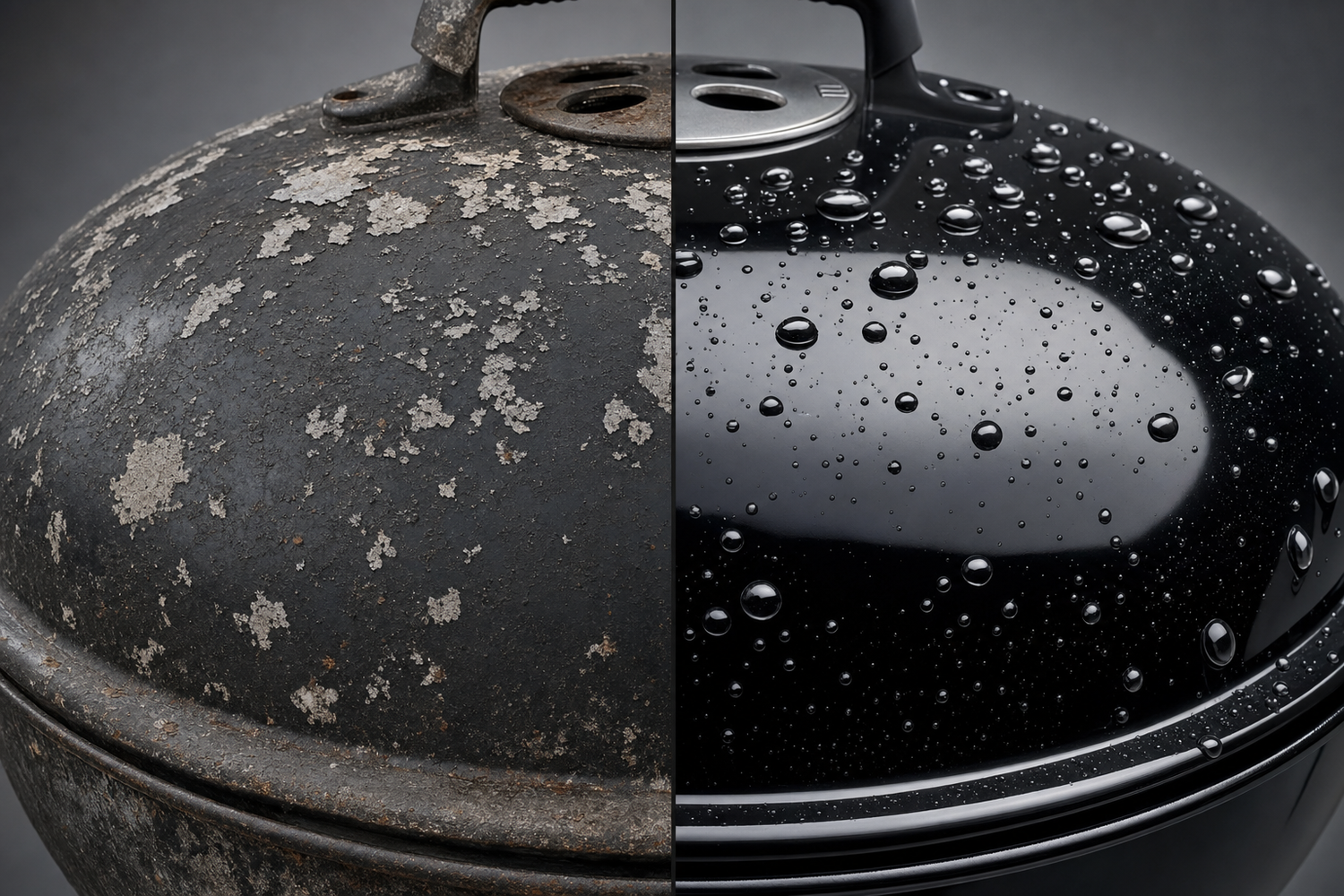
Your grill's finish starts to chalk, fade, or peel. You walk into a hardware store, pick up a can of high-heat spray paint for $12, and figure the problem is solved. It is not. You have applied a temporary cosmetic fix to a structural surface problem, and in one to two seasons you will be back at the hardware store doing it again. The mistake is understandable -- high-temp paint looks like the right answer. It handles heat, it covers the damaged area, and it is cheap. The issue is what it does not do at the molecular level.
Understanding the difference between paint and ceramic coating is not chemistry trivia. It is the difference between a maintenance cycle and a protection strategy.

What High-Temp Paint Actually Is
According to Rust-Oleum's technical data sheet for their Specialty High Heat formula, the product is designed to resist dry heat up to 1,200 degrees Fahrenheit and "renew and protect" metal surfaces. It is a real product and it works within its parameters. What the data sheet does not say -- because no paint manufacturer can claim otherwise -- is that it forms a chemical bond with the substrate it covers.
High-temp paint sits on top of the metal. It is a coating in the literal sense -- a layer applied over a surface, held in place by mechanical adhesion rather than chemical bonding. The paint layer fills in micro-roughness on the metal surface and grips it through that texture. This adhesion is compromised by grease contamination, UV exposure, moisture cycling, and the thermal expansion and contraction that happen every time you fire up the grill. Adhesion that depends on mechanical grip degrades over time with each of those stressors.
The result: high-temp paint on an exterior grill surface typically begins to chalk or flake within one to two seasons of normal use. On surfaces that see direct grease exposure -- side panels, lid liner, front face -- degradation can be faster.
What Ceramic Coating Actually Is
Ceramic coatings are chemically different at a fundamental level. The active chemistry is silicon dioxide (SiO2) -- the same compound that makes glass -- suspended in a carrier solution. When applied to a clean metal surface, the SiO2 molecules undergo a condensation reaction with hydroxyl groups on the metal surface, forming Si-O-Me bonds. Those are chemical bonds, not mechanical adhesion.
The result is a glassy layer that is part of the surface rather than sitting on top of it. According to Xometry's technical overview of ceramic coating chemistry, this bond provides increased surface hardness, reduced friction, enhanced corrosion resistance, and thermal insulation -- properties that emerge from the bond itself, not from the film sitting on top.
This distinction has real consequences: paint can be removed by a pressure washer, a solvent, or aggressive cleaning. Properly cured ceramic coating cannot. It has to wear down at the molecular level, which happens far more slowly than surface adhesion degrades.

The Difference Across a Grill's Lifetime
Consider what a grill exterior faces over a typical outdoor season: UV radiation for 6 to 8 hours per day during summer months, temperature cycles from ambient to 400+ degrees and back to ambient, rain and moisture exposure, grease splatter at cooking temperature, and whatever cleaning the owner applies. Each of these stressors attacks the surface independently.
A paint layer responds to all of them by gradually losing adhesion. Chalking is UV degradation of the paint binder. Flaking is adhesion failure from thermal cycling. Blistering is moisture trapped under the paint layer during temperature swings. Each mode of failure is a consequence of a surface layer that is not actually bonded to what it is protecting.
A ceramic layer responds to these same stressors at a different scale. UV hits the glass-like surface and is reflected or absorbed without degrading the polymer binder -- because there is no polymer binder. The coating is inorganic. Thermal cycling expands and contracts the metal, but the ceramic bond has enough flexibility to accommodate this without delaminating. Moisture repels rather than penetrating because the ceramic surface is hydrophobic by nature.
The Cosmetic vs Structural Distinction
This is the aha: paint is cosmetic. It makes the surface look better for a while. Ceramic is structural -- it changes what the surface is, not just what it looks like.
If your grill's powder coat has already degraded past the point of easy recovery, paint is not a bad interim step to stop the visual deterioration. But applying paint as a final solution is choosing to repeat the maintenance cycle every two seasons indefinitely. Applying a ceramic coating like Grillacoat after proper surface prep creates a bond that lasts multiple years -- and the surface prep required is a thorough clean and wipe-down, not the sanding and priming sequence a paint job demands.
The Practical Comparison
Paint: $12 per can, 1 to 2 season lifespan, cosmetic coverage, no change to surface chemistry, degrades via chalking and flaking.
Ceramic coating: one-time application, multi-year bond, hydrophobic and UV-resistant surface change, no repeat maintenance cycle.
If you own a grill worth protecting, the paint aisle is the wrong aisle. Grillacoat ships free with a 30-day guarantee, and the entire application takes about 10 minutes per panel.