
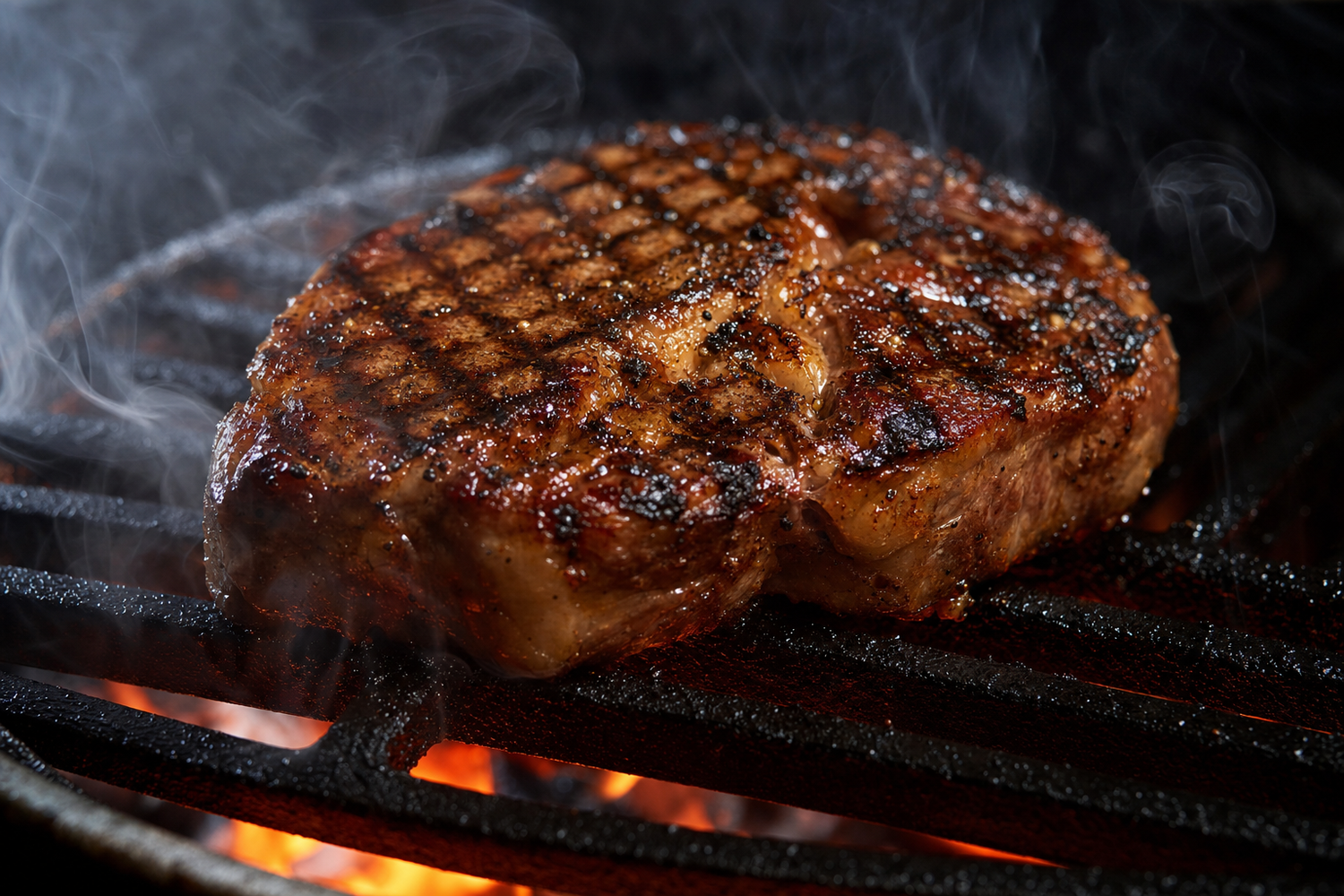
You put the steak down, walk away for two minutes, come back to flip it, and the whole thing tears. You lose that gorgeous crust, half the surface stays welded to the grate, and you are left with a ragged piece of meat that tastes fine but looks like a problem. This happens because of protein chemistry, and it happens on dirty grates at a dramatically higher rate than on clean, well-seasoned ones.

Why Protein Bonds to Metal
Raw meat contains myosin and actin -- the primary structural proteins in muscle tissue. When these proteins contact a hot metal surface, they denature: their molecular structure unfolds and the exposed reactive sites bond to whatever surface they are touching. On a clean, well-seasoned grate with adequate heat, this initial bond is temporary. As the Maillard reaction progresses and the crust develops, the proteins contract and pull away from the metal surface, releasing the steak cleanly.
On a contaminated grate -- one with carbonized fat residue, old protein deposits, or rust pitting -- the denaturing proteins bond not just to the metal but to the existing debris layer. That debris layer has a much higher surface adhesion coefficient than clean, seasoned metal. The protein does not release during crust development because it is anchored to a substrate that is itself bonded to the grate. The steak tears.
The Three Conditions That Produce Clean Release
Condition 1: Clean grate surface. A grate that has been brushed clean of carbon buildup and debris allows the initial protein contact to occur on a predictable surface. The proteins denature and bond to clean metal, and the Maillard reaction proceeds to completion, allowing the natural release that follows crust formation.
Condition 2: Adequate preheat. A grate that has not reached proper cooking temperature before the steak is placed will cause the meat to steam rather than sear. Steam prevents crust formation, and without crust formation, the protein release mechanism never triggers. The steak sits on a warm, damp surface bonded by steam-softened protein that has no reason to release. The minimum preheat for a steak cook on most grates is 450-500°F surface temperature -- verify with an infrared thermometer rather than guessing.
Condition 3: Leave it alone. A steak that is moved before the crust has fully formed will tear regardless of grate condition. The release mechanism requires the Maillard reaction to complete on the contact surface. Lifting the steak early -- to check the crust, to reposition it, to peek at the grill marks -- interrupts the process and tears the incomplete crust. Place the steak and do not touch it until it releases voluntarily or until the visual and timing cues indicate the crust is complete.
What Dirty Grates Are Actually Doing
The carbon buildup on an uncleaned grate is not inert seasoning. It is a heterogeneous layer of partially combusted fat, sugar residue from marinades and sauces, and protein fragments from previous cooks. This layer has several properties that work against clean meat release.
First, it is hydrophilic -- it absorbs moisture from the meat surface, creating a steam-producing layer between the meat and the hot metal. This steam delays crust formation and keeps the contact zone in a humid, low-sear environment. Second, it has irregular surface chemistry that creates unpredictable bonding sites. The myosin and actin proteins bond strongly to some areas and weakly to others, producing inconsistent release -- some areas of the steak release cleanly while others tear. Third, over time this layer incorporates rust from the underlying metal, which is porous and creates a mechanically rough surface with high grip on denaturing proteins.
The Role of Grate Seasoning
A properly seasoned cast iron grate has a polymerized oil layer bonded to the metal surface. This layer is hydrophobic -- it repels moisture rather than absorbing it -- and it has a relatively low surface adhesion coefficient compared to bare metal or carbon buildup. Proteins denatured on a seasoned surface bond less aggressively and release more cleanly as crust formation completes.
Maintaining this seasoning layer is straightforward: after each cook, brush the grates while hot, apply a thin coat of high-smoke-point oil with a cloth or paper towel, and let the residual heat cure the oil onto the surface. The cycle of heat-brush-oil-cure maintains the protective seasoning layer that enables clean release.
A grate that has been neglected past the point of simple brushing -- one with thick carbon buildup, rust pitting, or a surface that the seasoning layer cannot rehabilitate through normal maintenance -- should be replaced or restored. Restoration involves burning off the accumulated carbon at high temperature, brushing clean, and re-seasoning from scratch. This works on cast iron grates that are structurally sound. Grates with significant rust pitting do not hold seasoning reliably and should be replaced.
Oil the Steak, Not the Grate
A common approach to preventing steak sticking is oiling the grate immediately before placing the meat. This is less effective than it seems and potentially counterproductive. Oil applied to a very hot grate vaporizes almost immediately, providing minimal lubrication by the time the steak contacts the surface. Oil applied to a moderately hot grate smokes heavily and can flare, creating uncontrolled heat that chars the steak surface before the Maillard reaction is properly initiated.
The more reliable approach is to oil the steak itself rather than the grate. A thin coat of high-smoke-point oil -- refined avocado oil, refined safflower oil, or standard canola oil -- applied to the steak surface immediately before it goes on the grate provides a thin lubrication layer between the protein and the metal. This layer reduces the initial bonding force and improves the probability of clean release when the crust forms. It also helps the Maillard reaction initiate more evenly across the steak surface.
Timing the Flip
The correct flip time for a steak is when the steak tells you it is ready, not when your timer says two minutes. The visual cue is moisture: as the interior of the steak heats up, moisture migrates toward the cooler top surface and begins to appear as small beads or pools on the raw side. When you see this moisture appearing consistently across the top surface, the Maillard reaction on the bottom surface is typically complete and the steak is releasing from the grate.
The mechanical cue is resistance: a steak that releases cleanly will slide on the grate with minimal resistance when you apply gentle pressure with a spatula or tongs. A steak that resists movement is not ready. Apply no force -- forcing the flip before the crust releases is the direct cause of tearing. Wait 15-20 more seconds and test again.
Clean grates, proper preheat, oiled steak surface, and patience at the flip point are not separate tips. They are the components of a single coherent system, each one addressing a different part of the protein bonding and release mechanism. Missing any one of them increases the probability of sticking. Combining all four produces the clean, intact crust that moves freely from grate to plate.
Grate seasoning handles the cooking surface. For everything else on the grill -- the lid, hood, firebox exterior, cart, and hardware -- Grillacoat puts a ceramic barrier on the non-cooking surfaces so the only surface you're actively maintaining is the one that matters for the cook.