
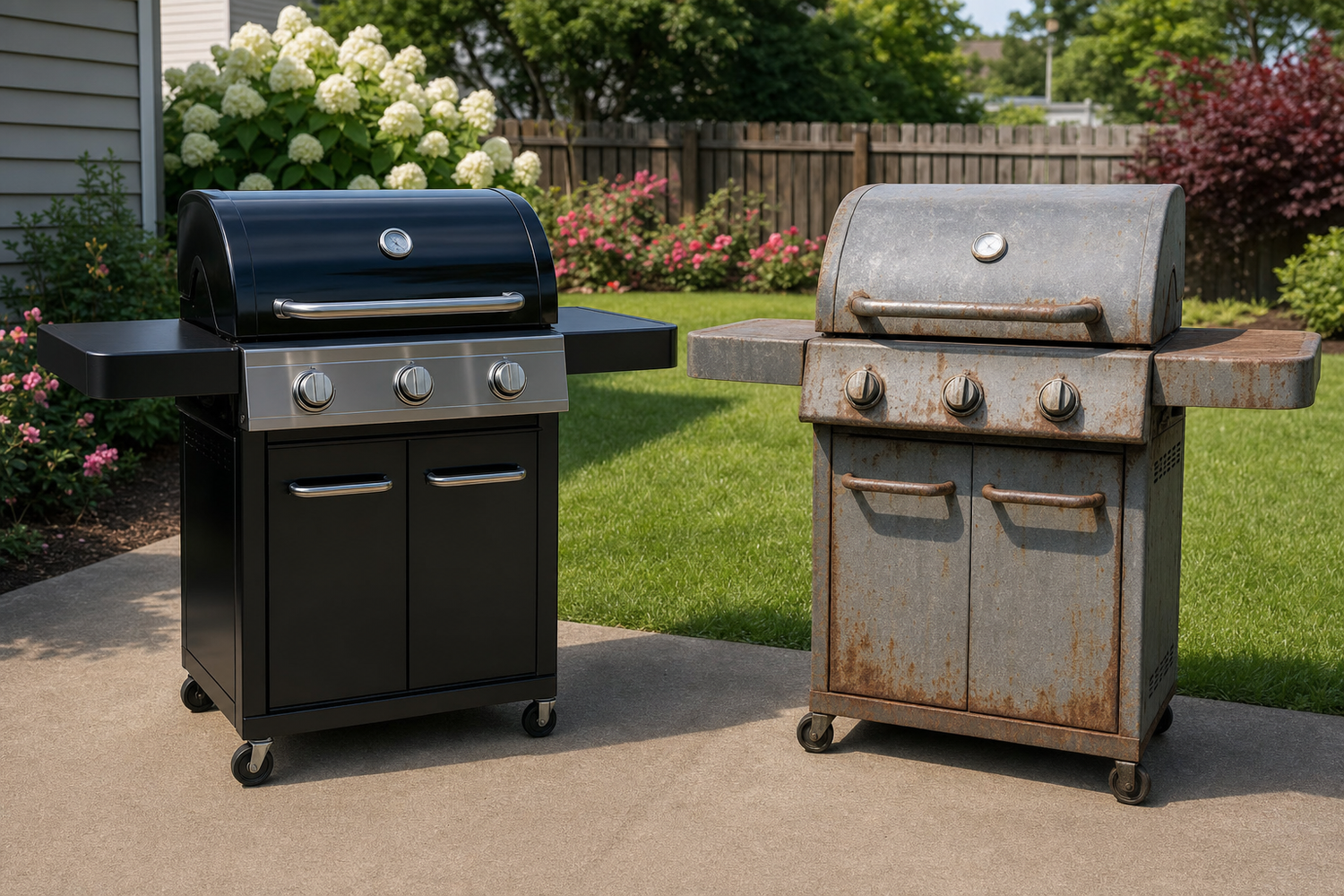
Browse Facebook Marketplace in any metro area right now and you will find more used grills than at any point in the past decade. Listings are up, prices are mixed, and sellers are confused about why identical models are moving at very different price points. The buyers are not confused. They are reading something in the listing photos that most sellers do not know they are broadcasting.

What the Marketplace Data Shows
The used grill market follows a consistent pattern: a well-maintained grill in clean finish condition sells for 60-75% of its original retail price within the first week of listing. The same model in poor finish condition -- visible rust, carbonized grease on the exterior, degraded grates -- sits for weeks and eventually sells for 20-35% of retail, often after multiple price reductions.
The brand premium that buyers pay at retail largely disappears in the secondary market when condition is poor. A neglected Weber Genesis does not command a premium over a neglected generic box-store grill. They are both grills that look like they were not cared for, and buyers price them accordingly. The brand premium survives in the secondary market only when the unit looks like the original owner took the brand seriously.
What Buyers Are Actually Looking At
In a marketplace listing, buyers see photos before they see price. The visual hierarchy of a grill listing is: exterior finish first, grates second, interior third, burners fourth. Price is evaluated relative to what they saw in that sequence.
Exterior finish signals overall maintenance history. A clean stainless exterior says the seller was the kind of person who maintained things. Rust streaks, oxidized panels, and grease buildup on the exterior say the opposite. This inference is not always correct -- some grills develop exterior finish issues despite good functional maintenance -- but buyers make it automatically, and pricing reflects it.
Grate condition is evaluated for functional serviceability. Buyers are looking for grates they can cook on immediately or that require only minimal seasoning. Grates that are pitted with rust, bent, or coated in carbonized material signal either that the grill was used hard without maintenance or that the grates are at end-of-life and will need replacement. Either interpretation lowers buyer willingness to pay.
Interior condition confirms or overrides the exterior signal. A clean exterior with a filthy interior suggests the seller cleaned up for the photos, which is a negative signal. A clean exterior with a well-maintained interior -- some carbon seasoning is normal and expected, but no grease pools, no rust-through on the firebox, no blocked burner ports -- confirms that the exterior finish reflects actual maintenance habits.
The Grate Replacement Math
Replacement grates for most major grill brands cost $40-120 depending on brand and grate material. If your existing grates are at the point where they are affecting buyer perception, replacing them before listing is almost always worth doing. A $60 grate replacement on a $500 grill that would otherwise list at $200 due to grate condition is a clear return on investment.
The math works differently for lower-value grills. On a grill that would list at $80 regardless of grate condition, a $60 grate replacement is not justified. The decision point is whether the grate condition is the primary factor holding the listing price down or whether the overall condition of the grill is the limiting factor.
Exterior Finish Restoration
Light rust streaks on stainless panels can be removed with Bar Keepers Friend and a microfiber cloth, working with the grain. This takes 15-20 minutes and costs under $5 in materials. The result on a listing photo is significant -- the difference between a grill that appears neglected and one that appears maintained.
Deeper rust on stainless panels, or rust on painted steel panels, requires more intervention. Rust converter products halt active corrosion but leave a visible dark finish that does not photograph as clean stainless. For painted panels, touchup paint in the original color can restore appearance if the rust is caught before it has produced significant surface texture. Heavily rusted panels are typically not worth the restoration effort on a grill that is being sold rather than kept.
The practical approach: clean everything that can be cleaned quickly and cheaply, replace components where the math works, and price honestly for condition issues that cannot be economically addressed. Buyers who inspect in person will find condition issues regardless. Listing photos that accurately represent the grill's condition attract buyers with accurate expectations and produce fewer failed transactions.
The Listing Photo Strategy
Most used grill listings are photographed in whatever condition the grill happens to be in when the seller decides to list. The listings that move quickly are photographed after a basic cleaning session -- typically two to three hours of work that produces a meaningful improvement in visual presentation without requiring significant expenditure.
The cleaning sequence that produces the best listing photos: clean the exterior stainless first (this is the hero shot), remove and clean or replace the grates, clean the lid interior, photograph with the lid up showing clean grates and interior, then photograph the exterior from a 3/4 angle that shows both the front and side panels.
Natural light on a clear day produces better listing photos than flash photography. Flash washes out the stainless finish and flattens the appearance of the grill. Side-angle natural light shows the condition of the stainless finish accurately, which works in your favor if the finish is clean.
Pricing Strategy
The used grill market has efficient pricing at the top and bottom of the condition range. Grills in excellent condition at fair prices move quickly. Grills in poor condition at unrealistic prices sit indefinitely and eventually sell at the buyer's price after multiple reductions.
The least effective strategy is listing at a high price with the intention to negotiate down. Buyers who see a poorly conditioned grill priced at 70% of retail do not offer 50% -- they scroll past to the next listing. The negotiation from an overpriced listing happens at the zero-interest point, which is no negotiation at all.
Price for condition, photograph for condition, describe the maintenance history accurately, and the listing will attract buyers at the right price point. The secondary market rewards sellers who understand what buyers are reading in the photos.
If you want to stop exterior oxidation before it shows up in listing photos, Grillacoat is a wipe-on ceramic coating for the non-cooking exterior surfaces -- lid, hood, panels, hardware -- that takes about 10 minutes and keeps the stainless looking like you actually maintained it.