
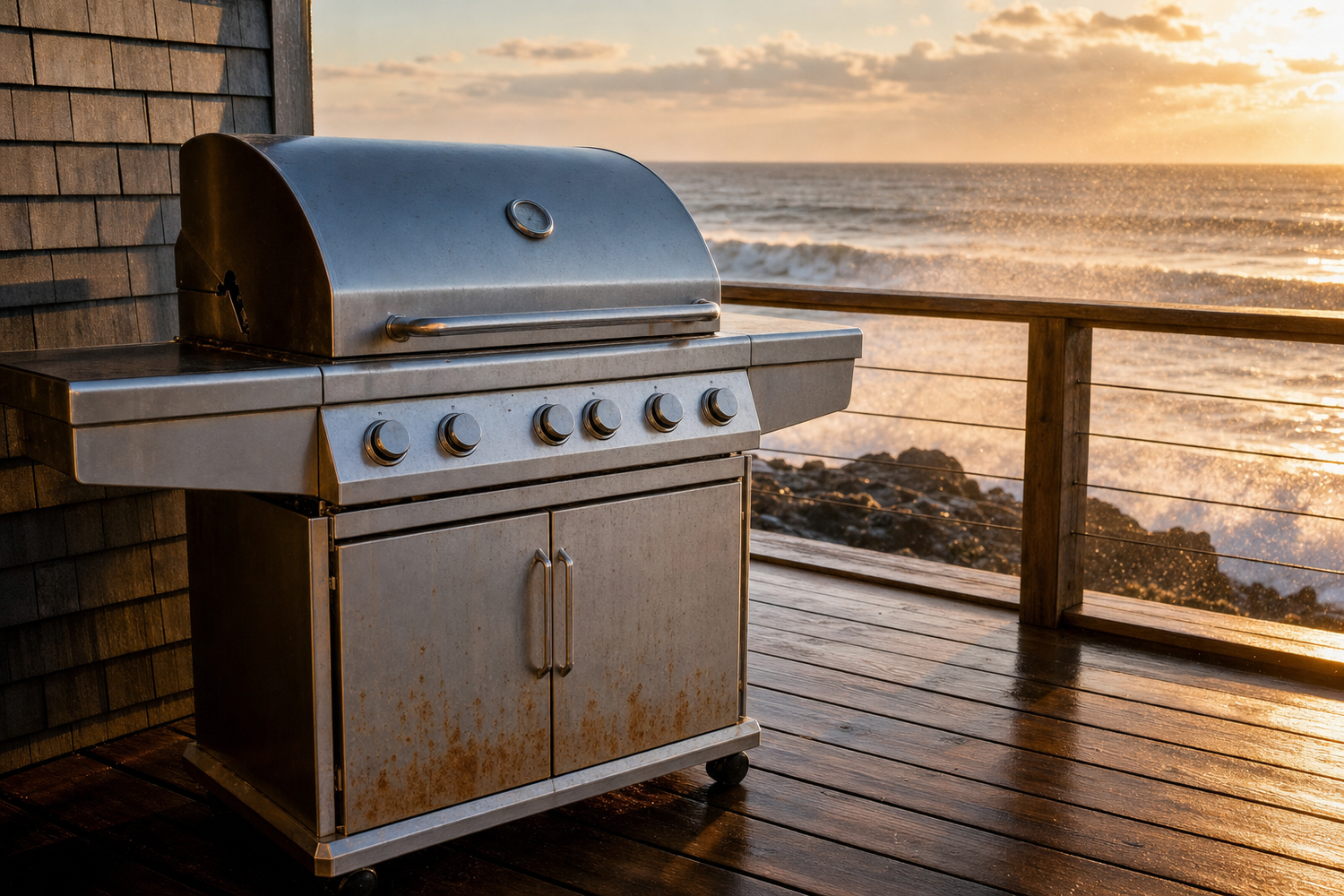
You paid $400, $600, maybe $800 for a quality grill. The box said stainless steel. The marketing implied longevity. What nobody told you is that within a mile of the ocean, the warranty clock moves at a different speed. Coastal grills don't last three to five years under normal maintenance schedules. They last one to three years without specific countermeasures, and the failure mode is almost always the same: chloride corrosion that starts at the surface and works inward until structural components fail.

What Salt Air Actually Does to Stainless Steel
Stainless steel resists corrosion through a passive oxide layer -- a thin film of chromium oxide that forms on the surface and prevents oxygen from reaching the underlying iron. This passive layer is self-healing under normal conditions: minor scratches and abrasions re-oxidize and the layer reforms. The problem with chloride environments is that chloride ions attack the passive layer chemically, penetrating it at weak points and initiating localized corrosion called pitting.
Pitting corrosion is insidious because it is not visible as a surface rust bloom until it is already advanced. The initial attack happens at a microscopic level -- a pit forms, grows inward, and undercuts the surrounding passive layer. By the time you see a rust spot on a stainless panel, the corrosion has already progressed significantly beneath the surface. What looks like a small rust spot may be a pit extending several millimeters into the metal.
Grade 304 stainless, which is used in most consumer and mid-range grills, is particularly vulnerable to chloride attack. Grade 316 stainless adds molybdenum to the alloy, which significantly improves chloride resistance. Marine-grade applications typically specify 316. Most grill manufacturers use 304 because it is substantially cheaper, and because in non-coastal environments it provides adequate corrosion resistance.
The Distance Gradient
Salt air concentration is not uniform -- it decreases with distance from the water. Grills within 500 feet of the ocean are in the most aggressive environment: constant salt aerosol deposition, high humidity, and minimal opportunity for salt to wash off between exposures. Grills between 500 feet and one mile experience moderate salt exposure. Beyond a mile, salt concentration drops to levels that most standard stainless can handle under normal maintenance.
The practical implication is that coastal grill maintenance is not a binary -- it is a gradient based on your specific location. A grill on a second-floor deck 200 feet from the surf line in a humid climate needs maximum countermeasures. A grill two blocks inland with some tree coverage needs less aggressive intervention. Assess your actual location rather than applying a blanket protocol.
The Countermeasures That Actually Work
The single most effective countermeasure for coastal grill corrosion is also the simplest: cover the grill every time it is not in use. A quality grill cover prevents salt aerosol deposition on the stainless surfaces between cooking sessions. Salt that never lands on the metal cannot initiate pitting. Most coastal grill owners who do not cover their grills understand intellectually that covering would help -- the failure is execution, not knowledge. Make it automatic: cook, cool, cover.
The second countermeasure is regular washing of the exterior surfaces with fresh water. This is not a cleaning session -- it is a salt removal session. Salt deposits that are washed off before they can concentrate and penetrate the passive layer cannot initiate pitting. A quick rinse with a garden hose after each use, followed by drying with a cloth to prevent standing water, reduces chloride exposure dramatically. This takes three minutes. The difference in grill lifespan between a coastal grill that is rinsed and dried regularly and one that is not is measured in years.
The third countermeasure is periodic application of a protective barrier coating to exterior stainless surfaces. Dedicated stainless steel protectants create a thin hydrophobic film that prevents salt aerosol from reaching the metal surface directly. These products need to be reapplied every four to six weeks in high-exposure environments. Combined with regular rinsing and consistent covering, this protocol can extend coastal grill lifespan to five years or more even with 304 stainless.
Hardware Fails First
The stainless panels on a coastal grill will show corrosion before they fail structurally. The hardware -- lid hinges, handle mounting hardware, control knob shafts, cart leg connectors -- often fails functionally before the panels become a structural problem. Hardware in coastal environments is typically a mix of stainless grades, plated steel, and zinc alloys. Plated steel and zinc alloys in chloride environments corrode aggressively.
A coastal grill where the lid hinge has seized, the handle screws have corroded to the point of strip-out, and the control knob shafts are rusted to the valve bodies is effectively at end-of-life even if the burners still work and the stainless panels look acceptable. Functional replacement of corroded hardware extends grill life if the underlying structure is sound, but hardware failure is typically an indicator that the overall corrosion burden is advanced.
When to Replace vs. Repair
A coastal grill showing surface rust spots on stainless panels within the first two years of ownership is experiencing accelerated corrosion. Surface rust can be treated with a stainless steel rust remover and the passive layer can be partially restored with a passivation treatment, but a grill that is pitting within two years in a coastal environment will continue to pit faster than intervention can address.
The replacement decision for a coastal grill should account for the total cost of maintaining a 304 stainless grill in a chloride environment versus the cost of a 316 stainless or alternatively-constructed grill that handles the environment correctly from the start. A $600 304 stainless grill that requires replacement in three years has a higher total cost of ownership than a $900 316 stainless grill that lasts ten years under the same conditions.
Some manufacturers offer coastal or marine-spec versions of their standard grill lines with 316 stainless on critical exterior components. These cost more at purchase and are worth the premium for owners within a mile of the water. The component-level specification matters: a grill advertised as having a 316 stainless cooking grate but a 304 stainless exterior is not a coastal-grade grill -- the exterior panels are what face the salt air environment.
The Grate Calculus
Cooking grates in coastal environments face a different corrosion challenge than exterior panels. Grates cycle from high heat during cooking to ambient temperature between sessions, and they collect moisture, fat, and salt simultaneously. Cast iron grates in coastal environments rust faster than their inland counterparts -- the protective seasoning layer is attacked by the same chloride chemistry that attacks stainless, and maintaining the seasoning layer in a high-humidity environment requires more frequent attention.
Stainless rod grates in coastal environments develop surface rust faster than at inland locations. The cooking surface itself is less affected -- the heat cycles during cooking partially maintain the surface -- but the underside of the grate bars, which receives less heat and more moisture, can develop rust pitting within one to two years. Inspect the underside of your grates regularly in coastal conditions.
The three-year lifespan figure for coastal grills without protective measures is not hyperbole -- it is a reasonable expectation based on the corrosion chemistry. The countermeasures exist and they work. Cover, rinse, protect, and inspect regularly. The ocean is not negotiable, but corrosion is manageable with consistent attention.
If you want a ceramic barrier specifically engineered for the non-cooking exterior surfaces of your grill -- lid, hood, firebox panels, cabinet, hardware -- Grillacoat applies in about 10 minutes and bonds to the stainless before the next salt-air session starts.