
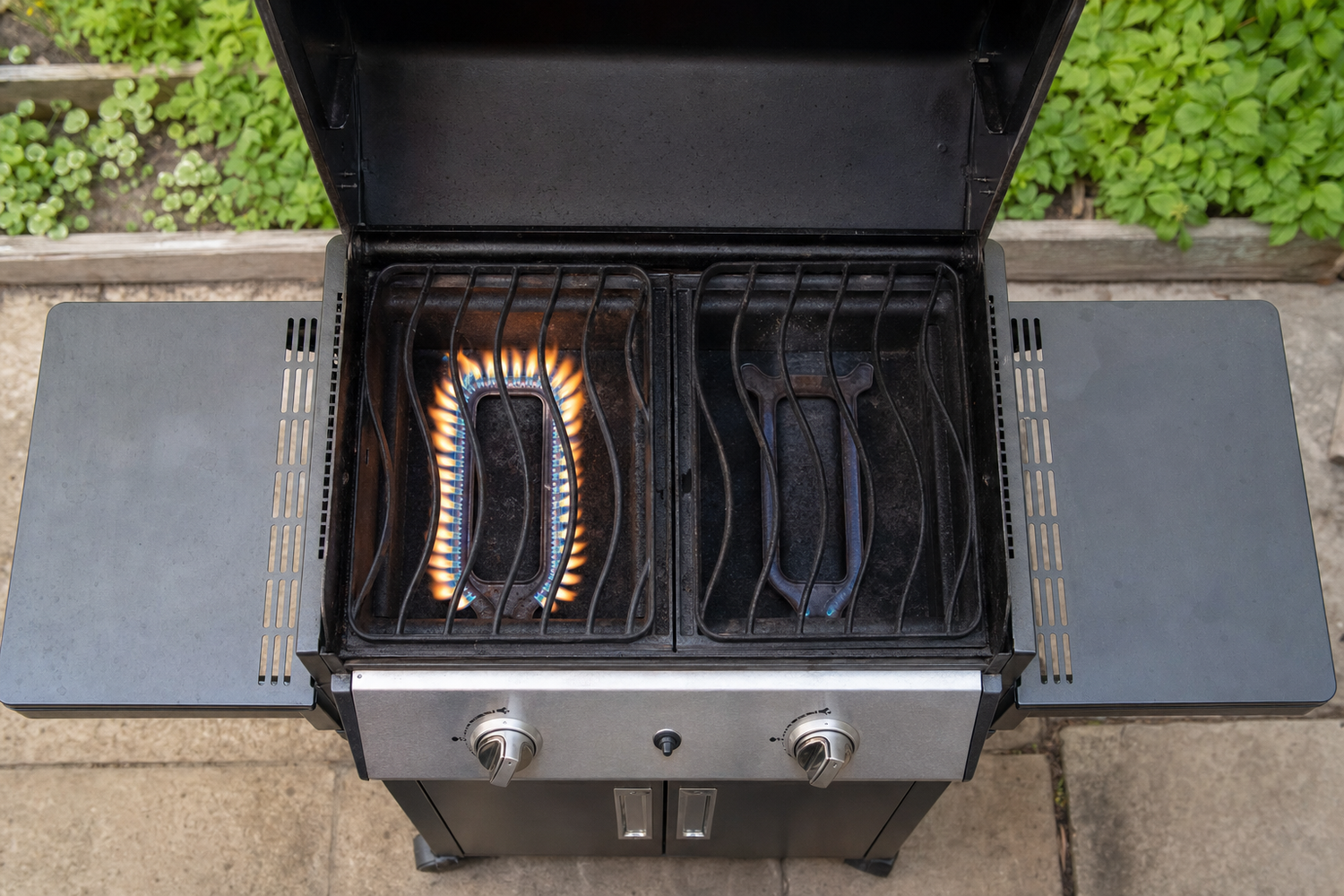
You put the burgers on, wait the same amount of time, and somehow the ones on the left are done while the ones on the right are still pink inside. You rotate everything, hope for the best, and chalk it up to "the grill being quirky." Here is the reality: uneven heat on a gas grill is almost never a quirk. It is a specific, diagnosable problem with a specific fix. And most of the time, that fix takes under 15 minutes.

First, Confirm the Problem
Before you start pulling things apart, verify the heat pattern. Preheat your grill on medium-high for 10 minutes with the lid closed. Then place a layer of white bread slices across the entire grate. After 60 seconds, lift and check the toast pattern. Dark areas are hotter; pale areas are cooler. This technique, used by professional equipment testers and outlined in testing protocols at Serious Eats, gives you a clear visual map of your grill's temperature distribution before you do anything else.
What you are looking for: is one side consistently pale while the other is dark? Are there banding patterns across multiple burners? Is one specific area completely uncooked? The pattern tells you exactly which cause you are dealing with.
Cause 1: Clogged Burner Ports
Gas burner tubes have small holes -- ports -- along their length that distribute the flame evenly. Over time, grease, food debris, and oxidation partially block those ports. When some are blocked and others are clear, you get uneven flame distribution and hot spots on one side or in specific bands.
The fix: turn the gas off completely, remove the grates and heat tents (the triangular or tent-shaped shields sitting over the burners), and inspect each burner. You should see small holes every inch or so along the tube. Use a stainless steel wire or a toothpick to clear any clogged ports, working from the outside in. Do not use the burner tube brush in a way that pushes debris into the tube; work the ports individually. This takes about 10 minutes per burner and costs nothing.
Cause 2: Warped or Missing Heat Tents
Heat tents (also called flavorizer bars, depending on the brand) sit between the burners and the grates. Their job is to vaporize drippings and distribute heat evenly across the cooking surface. When they warp -- which happens from years of thermal cycling -- they create high-heat and low-heat pockets directly above them.
Inspect yours: if they are visibly bent, rusted through, or misaligned, that is your culprit. Replacement heat tents run $20-$40 for most major brands and install in minutes. Straightening a slightly warped tent with pliers can also work as a short-term fix.

Cause 3: Regulator Bypass Mode
If your grill suddenly seems much weaker overall (low flame on all burners), you may have triggered regulator bypass mode. This is a safety feature that restricts gas flow when the regulator senses a rapid pressure drop -- which happens when you open the tank valve too quickly. In bypass, the grill runs at about 10% of normal output and cannot reach normal temperatures.
The fix: turn off all burner knobs, close the tank valve, disconnect the regulator from the tank, wait 30 seconds, reconnect slowly, open the tank valve slowly (one full turn per second), then light normally. This resets the safety mechanism. Many grillers who think they have a broken regulator just need this 2-minute reset, as documented in troubleshooting guides from Weber's maintenance resources.
Cause 4: Blocked Venturi Tubes
Venturi tubes are the flared intakes at the back of each burner where air mixes with gas before ignition. Spiders, wasps, and mud daubers love to nest in them during storage -- they are the perfect size and shape for a mud nest. A partially blocked Venturi tube causes an irregular, weak, or yellow flame on that burner.
To check: with the gas fully off, look down the Venturi tube from the front of the grill with a flashlight. You should be able to see through to the end. If you see an obstruction, a flexible brush designed for this purpose (sold at most hardware stores) clears it in minutes. This is the most commonly overlooked cause of uneven grill heat, particularly after the grill sits unused for a few weeks.
The Bigger Point -- And One Extra Step
Uneven heat ruins food and wastes fuel. But it is almost always a fixable mechanical issue, not a fundamental flaw in your grill. Clogged ports, warped tents, bypass mode, and blocked Venturis account for the vast majority of heat complaints. Work through the list, start with the easiest fixes, and you will almost certainly find the problem before you spend any money.
Once you have fixed the immediate issue, consider what allowed it to develop. Grease accumulation that blocks ports happens faster on rough, oxidized surfaces. Grillacoat bonds to exterior and lid liner surfaces, creating a smoother, sealed finish that accumulates less debris between cooks. It will not unclog a burner, but a well-maintained exterior makes the next 15-minute diagnostic a 5-minute one.