
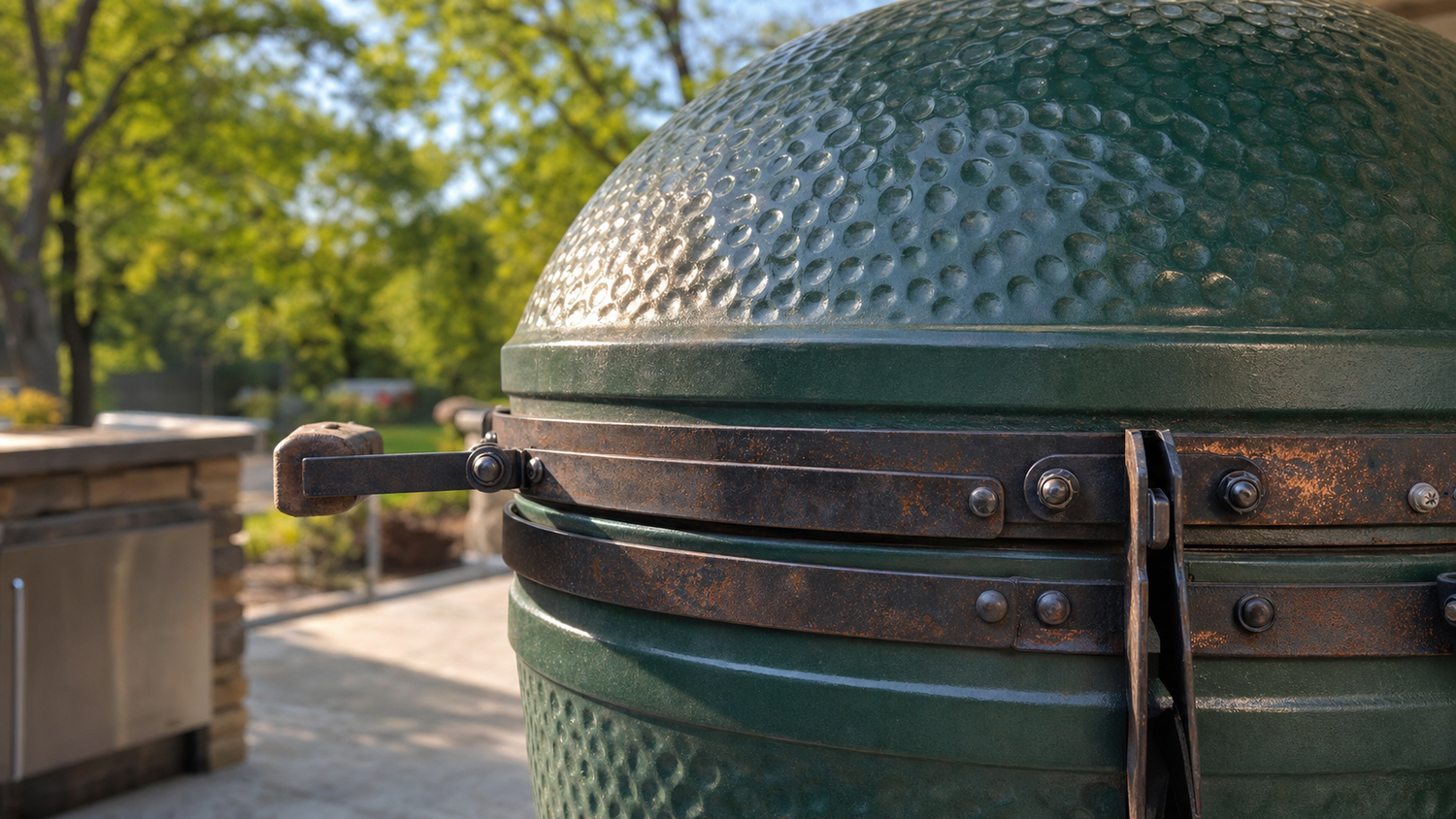
You spent north of $1,500 on a Big Green Egg or Kamado Joe. The ceramic dome is nearly indestructible -- owners post photos of eggs still cooking after 15 to 20 years with the original ceramic fully intact. But there is a persistent failure point in every kamado design that the ceramic narrative obscures: the hardware. The bands, hinges, latches, draft door, and daisy wheel are the parts that actually wear, and they wear faster than most buyers expect.

What the Hardware Actually Does
The ceramic dome and base are passive structural components. They hold heat and regulate the cooking environment. The hardware is the active mechanical system: the band holds the dome to the base under constant thermal stress, the hinge controls dome movement and positioning, the latch keeps the dome seated during cooking, the draft door controls airflow at the bottom, and the daisy wheel controls airflow at the top.
All of these components operate in a high-heat, high-humidity environment with repeated thermal cycling. A kamado running at 250°F for a 12-hour brisket cook expands and contracts significantly over that period. The hardware absorbs that movement. Over time, repeated thermal cycling fatigues metal components in ways that are invisible until they fail.
The Band System
The metal band that wraps the junction between the dome and base is the most structurally critical hardware component. On Big Green Egg, this is the stainless steel band with the hinge and latch attached. On Kamado Joe, the Classic and Big Joe use a similar band-and-hinge assembly.
Band issues present as dome misalignment -- the dome sits slightly off-center, creating an uneven gap that allows air infiltration. This manifests as temperature control problems: the cooker runs hotter than the vent settings suggest, or temperature holds are inconsistent across long cooks. If you are fighting temperature control on a kamado that used to be easy to dial in, inspect the band alignment before replacing any other components.
Band adjustment is typically a matter of loosening the adjustment screws, realigning the dome, and re-tightening. The procedure is straightforward on most kamado designs and does not require tools beyond a wrench. The issue is recognizing that band misalignment is the cause of the temperature control problem -- most owners attribute it to fire management technique rather than hardware.
Hinge Wear
The hinge is the highest-wear component in the system. It bears the full weight of the dome on every opening and closing cycle, at temperatures ranging from ambient to 700°F+. The hinge pin and barrel wear over time, producing increasing slop in dome movement. Eventually the dome no longer seats cleanly in the closed position -- it settles slightly off-center, creating the same air infiltration problem as band misalignment.
Hinge replacement is the most common kamado hardware repair. Replacement hinges are available from both Big Green Egg and Kamado Joe as direct-fit parts. The replacement procedure involves removing the dome (a two-person job given the weight), replacing the hinge assembly, and re-hanging the dome. The work is not technically complex but requires care to avoid cracking the ceramic at the hinge mounting points.
On Big Green Egg specifically, the spring mechanism in the hinge also controls dome counterbalancing. A worn spring allows the dome to fall closed under its own weight rather than staying in a raised position. This is both an inconvenience and a safety issue -- a falling dome on a hot kamado creates a burn hazard. If your dome no longer stays raised without being held, the hinge spring needs service or replacement.
Draft Door Corrosion
The bottom draft door slides open and closed to control combustion airflow. On most kamado designs, this is a cast iron or steel component operating in the ash zone -- the lowest part of the firebox where moisture, ash, and grease accumulate. This is the harshest environment for ferrous metal in the entire cooker.
Draft door corrosion presents as a door that sticks open or closed, or that no longer slides smoothly across its full range of motion. Once corrosion is advanced enough to affect movement, the airflow control is compromised -- you cannot make fine adjustments, which means you cannot hold precise temperatures. On a kamado, where the entire temperature control system depends on precise vent management, a sticky draft door is a significant functional problem.
Draft door replacement is inexpensive and straightforward on most kamado models. The issue is that most owners use penetrating oil or force when the door starts sticking, which masks the problem temporarily while the underlying corrosion continues to advance. Replacement is the correct solution once the door shows visible rust or movement resistance that returns within a season of treatment.
Daisy Wheel and Top Vent
The daisy wheel (top vent cap with sliding petals) is the fine-adjustment control for temperature management. The petals need to slide smoothly for precise airflow control. Carbon buildup and moisture exposure cause the sliding mechanism to stiffen over time. A stiff daisy wheel makes the difference between a 225°F hold and a 250°F hold -- which on a long smoke is the difference between the result you planned and a result you have to manage.
Daisy wheel maintenance is simple: periodic cleaning of the sliding mechanism with a wire brush and a light coating of food-safe high-temperature lubricant. Replacement is inexpensive if the mechanism is worn beyond cleaning. This is a maintenance item that most kamado owners neglect because the stiffening is gradual and the temperature impact is subtle until it is not.
The Felt Gasket
The felt gasket at the dome-base junction creates the airtight seal that makes kamado temperature control possible. New kamados have a thick felt gasket that compresses slightly when the dome is closed, sealing the junction. Over time, the gasket compresses permanently, chars in sections, and eventually fails to seal. A failed gasket produces the same air infiltration symptoms as band misalignment or hinge wear: temperature control problems and fuel efficiency loss.
Gasket replacement is the most frequently performed kamado maintenance task. The procedure involves removing the old gasket material (often a multi-session job if the original adhesive is well-bonded), cleaning the mating surfaces, and applying a new gasket with high-temperature adhesive. Third-party gasket kits are available and are often preferred over OEM gaskets for their material quality. The work requires patience but no special skills.
Hardware Lifespan Expectations
A realistically maintained kamado in a temperate climate can expect the following hardware service intervals: gasket replacement every 2-5 years depending on use frequency and cooking temperatures; daisy wheel cleaning annually, replacement every 5-8 years; draft door inspection annually with replacement as needed based on corrosion; hinge inspection annually with adjustment as needed, replacement every 8-15 years under normal use; band adjustment as needed, typically once every few years as the cooker settles.
In coastal environments or climates with significant freeze-thaw cycling, compress all of these intervals by 30-50%. Salt air accelerates corrosion on all ferrous and even some stainless components. Thermal cycling from freezing temperatures adds stress to both the ceramic and the hardware mounting points.
What This Means for Buying Used
A used kamado with perfect ceramic and compromised hardware is not a bargain at ceramic-condition pricing. The hardware replacement costs add up: a hinge assembly is $60-120, a full gasket kit is $30-60, a daisy wheel is $20-40, a draft door is $15-40. A used kamado needing a full hardware refresh is $150-250 in parts plus several hours of labor before it cooks as well as it should.
When evaluating a used kamado, open and close the dome and feel the hinge: it should be smooth with no lateral slop. Check the dome seating: it should settle evenly with no visible gaps around the band junction. Slide the draft door through its full range: it should move without resistance. Test the daisy wheel petals: they should slide with light finger pressure. Inspect the visible gasket: look for compression, charring, or missing sections.
The ceramic will probably be fine. Evaluate the hardware with the same rigor you would apply to any mechanical system, because that is what it is.
For the metal band, hinge exterior, cart hardware, and outer shell surfaces -- the non-cooking parts that take the corrosion burden -- Grillacoat is a wipe-on ceramic coating purpose-built for exactly this kind of exterior grill hardware. It won't stop a worn hinge from needing replacement, but it slows the corrosion that gets you there faster than it should.