
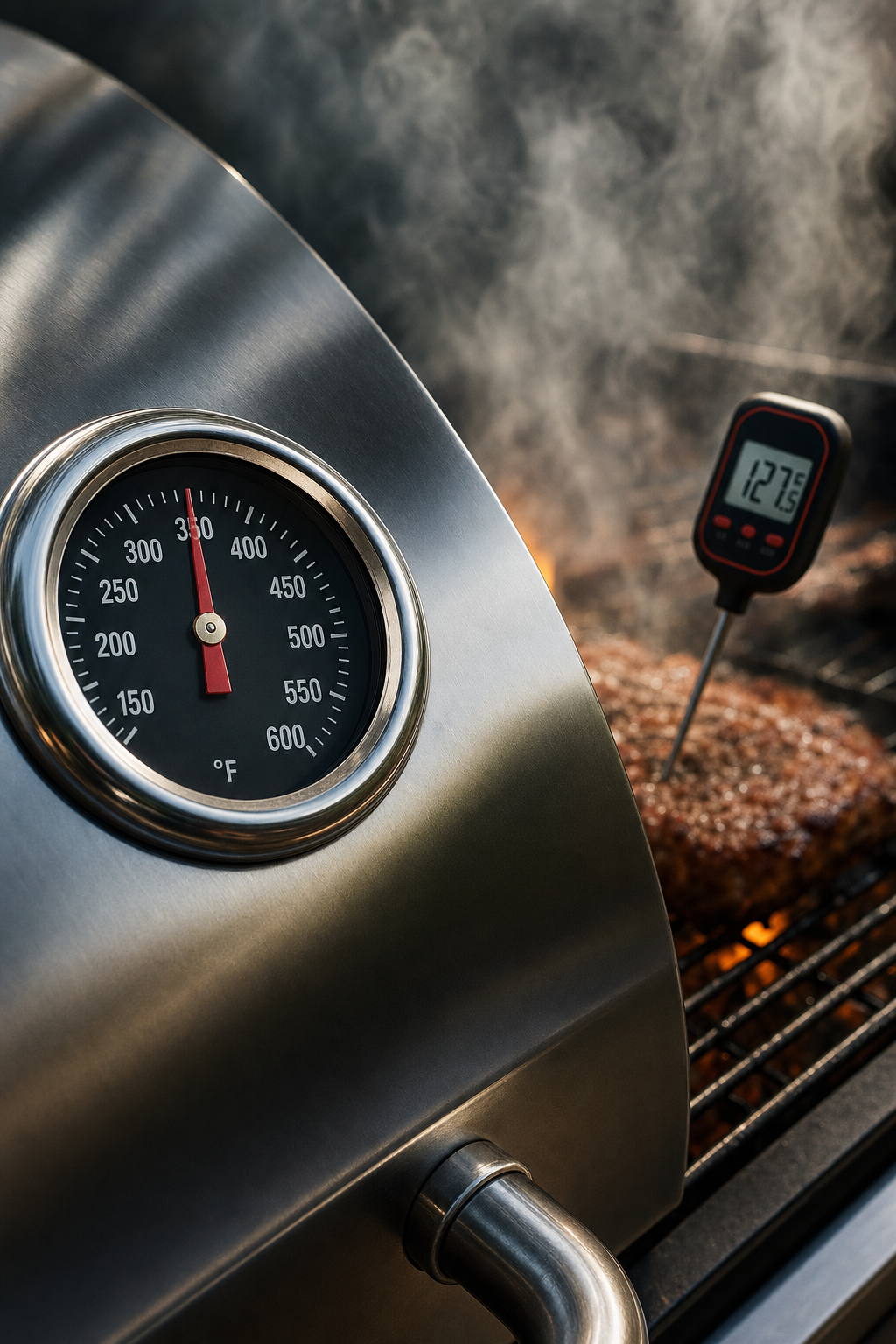
That dial on your grill lid has one job. It is failing at that job on every cook you do. The built-in thermometer measuring the air at the top of your dome is not measuring where your food actually lives -- and the gap between those two readings is large enough to turn a medium-rare steak into shoe leather without you doing anything wrong.

What the Lid Thermometer Is Actually Measuring
The standard dome thermometer sits one to two inches inside the lid at the very top of the dome. Heat rises. The hottest air in your entire grill collects up there, and that is exactly what the dial is reading -- the temperature of air that your food never touches.
ThermoWorks, which manufactures professional-grade probes used by competition pitmasters and test kitchens, is direct on this point: convection currents alone can produce a gap of as much as 50 degrees Fahrenheit between the dome reading and the air temperature an inch above your food. Every time you open the lid, the dome air temperature drops and the equilibration process starts over. Every time cold food hits the grate, the grate-level temperature drops while the dome reads something else entirely.
The thermometers themselves compound the problem. ThermoWorks notes that virtually all dome dials ship as afterthoughts -- cheap bi-metal coil instruments where physical shocks from slamming the lid knock the coil slightly out of alignment over time. Many have no recalibration adjustment. They are simultaneously measuring the wrong zone and doing it inaccurately.
How Big Is the Real Gap?
The difference between dome and grate readings varies by grill setup, but the data is consistent. ThermoWorks puts the convection gap at up to 50 degrees on a standard cook. Real-world reports from users with calibrated grate probes show 25 to 100 degrees of difference depending on conditions -- with colder weather pushing the gap toward the high end, since the dome cools faster than the grate. One documented cook on a Big Green Egg showed the dome reading 240 while a calibrated grate probe read 311 -- a 71-degree lie on a single cook.
On a gas grill at 350 degrees dome temperature, your actual grate temp could be anywhere from 300 to 425 degrees depending on burner configuration, lid seal condition, and ambient temperature. If you are following a recipe written for grate-level cooking -- as most are -- you are flying blind.
The Practical Consequences
Medium-rare steak comes down to a roughly 10-degree window. A chicken breast goes from juicy to dry within 20 degrees of overcook. When your dome reads 350 and your grate is actually at 425, the steak moves faster than every timing cue you have ever used. You pull it on schedule and it is overcooked. You blame your grill. The grill was doing exactly what you asked -- you were just asking based on wrong data.
The longer cooks see different problems. Dome reads 225 for a brisket cook, but grate is actually 195. The collagen in the brisket never fully renders. The cook takes two extra hours you did not account for. The grate is the environment that matters -- not the air column above it.
The Fix Is Straightforward

A grate-level probe clipped to the cooking grate, positioned an inch or two above the surface near your food, gives you the number that matters. The dome dial becomes a rough reference -- useful for confirming the grill is on and roughly in range, but not something you cook to. A leave-in probe thermometer with a grate clip starts well under $50. What you are solving is the habit of looking at the wrong instrument. Most cooks find their grill's offset is consistent -- 40 degrees, 60 degrees, whatever yours runs -- and can adjust accordingly.
What This Means for the Thermometer Face
One practical note on the dome thermometer itself: sun-baked plastic lens faces and metal bezels on outdoor grills degrade fast. After two or three seasons of UV exposure, the lens yellows, the numbers fade, and the dial becomes harder to read from even the short distance it sits from you. The instrument may be unreliable for cooking purposes, but a corroded face makes it useless even as a reference.
Grillacoat applied to the surrounding grill panel protects the metalwork around the thermometer bezel from the UV and moisture cycling that accelerates oxidation and finish breakdown. It will not fix the inaccuracy -- nothing short of a probe upgrade does that -- but it keeps the hardware presentable and slows the surface degradation that makes a cosmetically intact grill look neglected years sooner than it should.
The Simple Test to Know Your Grill's Actual Offset
Fire up the grill. Set the dome to 350. Let it stabilize for 15 minutes. Clip or rest a probe thermometer at grate level where your food normally goes. Write down both numbers. The difference is your grill's personal offset -- consistent across cooks, worth knowing, and completely invisible to anyone who relies only on the dome dial. Run that test once and you will cook more accurately on every cook that follows.