
Walk into any hardware store and you will find grill paints, wax-based protectants, and spray-on coatings promising to protect your grill's exterior. Most look great for one season. By month 18, they are peeling, chalking, or simply gone. The reason is almost never the product. It is what happened -- or did not happen -- in the 30 minutes before the product went on.

The Bonding Problem That Nobody Talks About in the Instructions
Any coating -- wax, paint, or ceramic -- can only bond to what it directly contacts. If the surface has polymerized grease, oxidation, or residue from a previous protectant sitting on top of the metal or powder coat, the new coating bonds to that contamination layer instead of the substrate. When that layer breaks down under heat cycling and UV, the coating goes with it. Grills present three specific contaminants that require deliberate removal before any coating goes on.
Contaminant One: Polymerized Grease
Every cook cycle pushes grease vapor outward through lid vents and around seams. Over a season, this deposits a thin, baked-on layer across exterior panels -- invisible to a quick wipe, tactile if you drag a finger across the surface. Standard household cleaners do not cut through polymerized grease. You need a degreaser rated for baked-on residue with some dwell time before wiping. Skip this and your coating bonds to carbon and grease instead of the panel. Heat cycling expands and contracts that residue beneath the coating. By summer's end, you see bubbling at panel edges. By spring, you have peeling. The product did not fail -- the prep did.
Contaminant Two: Silicone Residue from Old Protectants
The most common "grill care" products sold at hardware stores -- spray-on silicone wipes, appliance polishes, general-purpose protectants -- leave a silicone film behind that is specifically designed to resist heat and repel water. That is exactly what you want from a protectant. It is exactly what you do not want underneath a coating that needs to bond chemically to the surface.
Ceramic coating chemistry requires direct contact with the substrate to form its molecular bond. A silicone barrier between the coating and the surface prevents that contact from happening. The coating appears to go on correctly and may look good initially, but it is sitting on top of a silicone film rather than bonded to the metal below it. The first sustained heat event or heavy rain will reveal the problem.
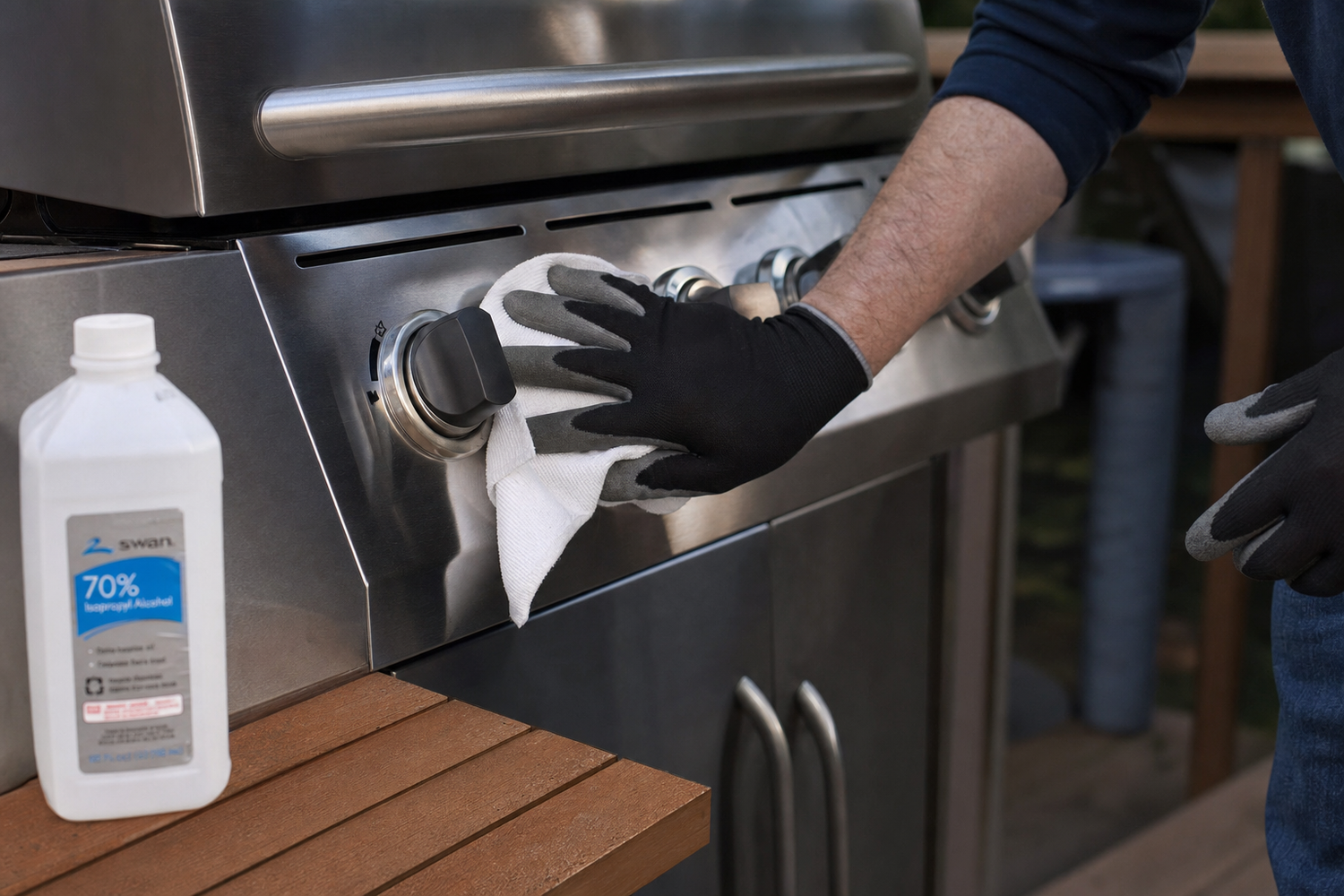
Removing silicone residue requires an isopropyl alcohol wipe -- at 70% concentration or higher -- across every panel you intend to coat. This step is standard practice in professional auto detailing prep and is the step most home applicators skip entirely because the surface looks clean to the eye. It is not.
Contaminant Three: Oxidation and Surface Scale
Powder-coated and painted grill surfaces that have been exposed to a full season or more of sun, rain, and heat cycling develop a layer of UV-degraded surface material -- the chalky, faded layer that appears on neglected finishes. Coating over this layer bonds to dead surface material rather than to the intact finish below it.
A light pass with a fine abrasive pad -- the equivalent of ultra-fine steel wool or a 000-grit equivalent -- removes the degraded surface and exposes fresh, intact powder coat or enamel for the coating to contact. This does not require power tools or significant abrasion; it is a light scuff with moderate pressure over each panel. Follow it with the IPA wipe and you have a surface that will actually hold what you put on it.
The Full Prep Sequence Before Any Coating

In order: degrease with a product rated for baked-on residue, allow it to dwell and wipe clean. Follow with a light scuff using a fine abrasive pad on any oxidized or faded panels. Wipe every panel with isopropyl alcohol and allow it to fully evaporate -- typically five to ten minutes at room temperature. Apply your coating only after this sequence is complete.
The IPA wipe is the step that separates a coating that bonds for one season from one that holds for multiple years. It takes ten minutes. Most people skip it because the surface looks clean after degreasing. It is not -- not at the molecular level where bonding happens.
Why Prep Rewards a Premium Coating More Than a Cheap One
Cheap waxes and silicone sprays bond superficially regardless of prep -- which is also why they fail regardless of prep. A ceramic coating forms a chemically durable multi-year bond to the substrate, but only on a clean, contaminant-free surface. Prep correctly and you get years of protection. Skip prep and you get one season, same as the cheap stuff.
Grillacoat bonds to powder coat, porcelain enamel, stainless steel, and cast aluminum -- the four most common grill exterior surfaces. Apply it after the degrease, scuff, and IPA sequence, and the application takes about 10 minutes per panel. The coating then has a clean surface to bond to, and the result is a finish that holds through multiple seasons rather than peeling off by the following summer.
The coating is not magic. The prep is the part that matters. Do the prep correctly and the coating rewards you with everything it promises.