
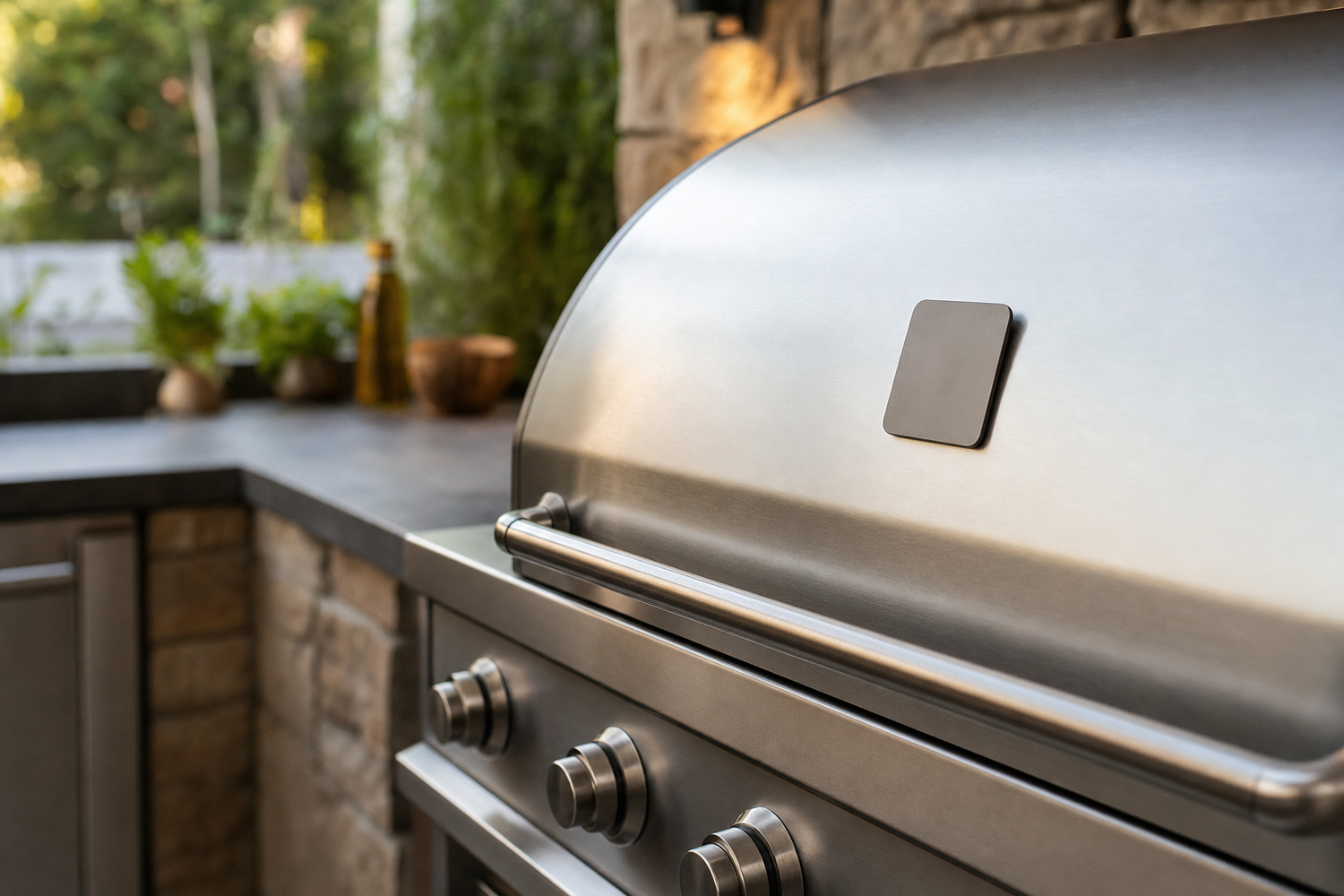
Walk out to your grill right now with a fridge magnet. Stick it to the lid. If it holds, you do not own a 304 stainless steel grill -- you own a 430. And there is a 99% chance the salesperson, the website, and the box never told you which one.

This is the most quietly profitable shell game in the outdoor cooking industry. The word "stainless" gets you to pay $899 instead of $399. The actual alloy decides whether the grill survives three summers or fifteen. And the test that exposes it costs you nothing.
The Two Stainless Grades Almost Every Grill Is Made From
There are two grades of stainless steel used in the vast majority of consumer grills, and they are not close to equivalent.
304 stainless steel contains roughly 18% chromium and 8% nickel. The nickel is the expensive part -- it is what creates the austenitic crystal structure that makes 304 non-magnetic and gives it the corrosion resistance everyone associates with the word "stainless." Per Kloeckner Metals' alloy comparison, 304 is "exceptionally" rust resistant in atmospheric and salt-air conditions.
430 stainless steel contains about 17% chromium and zero nickel. No nickel means a ferritic structure, which means it is magnetic and significantly more prone to rust, pitting, and crevice corrosion -- especially in humid or coastal environments. Per Reliance Foundry, 430 costs manufacturers 55-75% of what 304 costs to source. That margin is what makes the swap so attractive.
Both are technically "stainless." Only one is built for ten years of backyard weather.
The Magnet Test
Here is the test that takes five seconds and ends the conversation.
Pull a small magnet off your fridge. A flat business-card style works. Walk to your grill and press it against the lid, the firebox face, the side shelves, and the cart panels. If it sticks to any of those surfaces, that surface is 430 -- or, in rarer cases, an even cheaper 201 or 202 grade trying to imitate 304.
304 will not hold a magnet. Period. A real 304 lid will let the magnet fall straight off.
One catch worth knowing about: 201 and 202 stainless are non-magnetic when annealed, which means a manufacturer can technically pass the magnet test with the cheapest, most rust-prone grade of all. Reliance Foundry explicitly warns that this combination "can surprise a buyer into thinking they're getting 304 stainless at a very good price." If your grill is non-magnetic and was suspiciously cheap, you may have been double-fooled.
Why Manufacturers Mix Grades on the Same Grill
The clever part is that most mid-tier grills use both alloys on the same unit. The pieces you see -- front panel, visible lid, badged components -- might be 304. The pieces hidden from view -- firebox interior, cart, back of the lid -- are often 430 or worse.

This is why your "stainless steel" grill has a beautiful exterior and rust streaks bleeding down from the hinges after one winter. The hinge bracket is 430. The bolt running through it is plated steel. Water sits in the crevice, the chromium oxide layer cannot reform, and you watch your grill self-destruct from the inside of every joint outward.
The engineering explanation is that stainless steel only resists rust when its protective chromium oxide layer can constantly reform with oxygen contact. The moment moisture gets trapped under burned-on grease, paint, or a non-permeable contaminant, the steel suffocates and rust begins underneath. Lower-chromium grades suffocate faster.
What to Do When the Magnet Sticks
If the magnet stuck, you have three real options.
The first is the high-maintenance path: scrub after every cook, dry every surface, store under a perfect cover. It extends the life of a 430 unit but requires attention most people do not have time for.
The second is replacement, which is fine if you are about to buy anyway. Bring a magnet to the store. Test the lid, the firebox, the cart, the side shelves separately. Do not let a salesperson tell you "it's all stainless." Make them tell you which grade of stainless and on which parts.
The third is sealing the existing surface so the alloy underneath stops mattering. This is the entire reason ceramic protective coatings exist for grills. A coating like Grillacoat applied to the exterior of a 430 stainless grill creates a barrier that water, salt air, and grease cannot cross. The chromium oxide layer underneath stays intact because nothing is sitting on it long enough to do damage. The cheaper alloy starts behaving like the more expensive one because the environment never gets to touch it.
The Cost Math Most Owners Miss
A 304 stainless grill of a given size and feature set runs roughly $400-$700 more than its 430 equivalent. A bottle of protective ceramic coating runs a fraction of that and adds the same weatherproofing layer to whatever you already own.
If you are looking at a new grill, the upgrade-to-304 math sometimes wins. If you already own the grill the magnet just stuck to, the coating math almost always does. Either way, the first step is knowing what alloy is actually under your hand every time you open the lid.
Five seconds. One magnet. If it stuck, your grill is asking for help. Give it some: Grillacoat.